
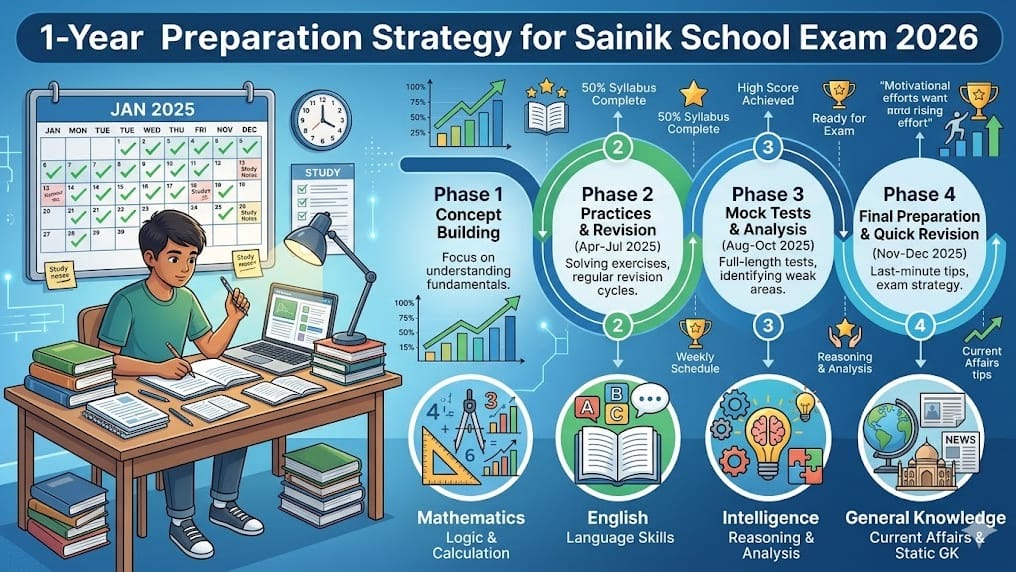
The families who score 240+ in AISSEE ↗ don't have a secret. They don't have magical resources unavailable to anyone else. What they almost always have is time - specifically, they started about 12 months before the exam.
A child who begins focused AISSEE preparation in January 2026 for the January 2027 exam has something that last-minute candidates don't: the ability to go deep on weak subjects, the time to genuinely improve rather than just cover topics, and the mental confidence that comes from months of consistent practice.
Here's how to use those 12 months properly.
First - Understand What You're Preparing For
The All India Sainik Schools Entrance Examination is a national-level admission test conducted annually for entry into Sainik Schools across India. The AISSEE 2026 exam pattern is designed to evaluate both conceptual knowledge and analytical skills. It is an objective-type test conducted in offline mode using an OMR sheet.
Class 6 exam: 300 total marks, 150 minutes duration, conducted in 13 languages including English and Hindi. No negative marking.
The Class 6 paper aims to test a student's overall aptitude and academic understanding from Classes 4 and 5.
Class 9 exam: 400 total marks, 3 hours duration. Topics include Algebra, Mensuration, Linear Equations, Geometry, Trigonometry basics, and Statistics in Mathematics. Focus on NCERT Class 8 Mathematics chapters and solve HOTS questions. Conducted in English medium only.
Subjects generally included in the AISSEE syllabus are Mathematics, Science, English, Social Studies, and General Knowledge and Awareness.
No negative marking in either paper. That matters for strategy - attempt everything, never leave a question blank.
Month 1 and 2 - Foundation and Honest Assessment
The first two months are not about speed. They're about honesty.
Start with a baseline mock test - full length, timed, under exam conditions. Not to score well. To find out exactly where the gaps are.
Students who excel at Mathematics and Intelligence and General Knowledge will obtain admission at these esteemed institutions. Prioritise high-weightage sections like Mathematics during preparation.
Mathematics is the highest-weightage subject in AISSEE for both Class 6 and Class 9. It's also the most improvable with consistent practice over time. If the baseline test reveals weak arithmetic, fractions, or geometry - these become the priority for months 1 and 2.
Daily study time in this phase: 2 to 2.5 hours. Not more. The goal is building the habit, not burning out eight months before the exam.
Month 1: NCERT textbook revision for Mathematics and Science. Chapter by chapter, with exercises fully completed - not skimmed.
Month 2: English grammar foundations - tenses, parts of speech, comprehension, vocabulary building. 15 minutes of English reading daily - newspapers, age-appropriate books - builds vocabulary naturally.
Month 3 and 4 - Subject Depth
By month 3, the foundation is laid. Now go deeper into each subject.
Mathematics for Class 6: Number system, fractions and decimals, basic algebra, geometry, mensuration, simple problems on ratio and proportion. Source: NCERT Class 4 and 5, plus standard AISSEE workbooks.
Mathematics for Class 9: Algebra, Mensuration, Linear Equations, Geometry, Trigonometry basics, Statistics. Focus on NCERT Class 8 Mathematics chapters.
Science: For Class 6, topics from Class 4 and 5 NCERT - plants, animals, human body, basic physical science. For Class 9, the scope broadens to Class 7 and 8 NCERT - light, sound, matter, living organisms, basic chemistry.
Social Studies and GK: These are areas where steady reading accumulates over time rather than cramming later. Stay updated on current affairs through age-appropriate news sources. Start a simple GK notebook - one page per week of new facts, discoveries, national events, geography facts, important dates.
Daily study time in months 3 and 4: 2.5 to 3 hours.
Month 5 and 6 - Intelligence and Mock Tests
The Intelligence section is a section many students underweight - and then find themselves stuck on during the actual exam.
Intelligence tests in AISSEE include series completion, analogies, coding-decoding, figure problems, logical sequences, and spatial reasoning. Practice mental math to improve speed and accuracy. This section rewards practice over theory. You don't study intelligence - you practice it until the patterns become automatic.
By month 5, introduce weekly mock tests. Not full-length every time - sectional tests work well here. One Mathematics mock per week. One English mock per week. One Intelligence section practice per week.
Track every mock result in a simple notebook: date, score, subjects weak, questions wrong, reason for error. Review wrong answers the day after each mock - not just "I got this wrong" but "I got this wrong because I don't understand how to set up ratio problems" and then go back and fix that specific gap.
Daily study time in months 5 and 6: 3 hours.
Month 7 and 8 - Revision and Speed
By month 7, all subjects have been covered at least once. The priority shifts from learning to retaining and speeding up.
The ideal strategy for students to do well on the entrance exam is to review the syllabus and take a series of online mock exams in accordance with the latest pattern - both a chapter-wise exam series and a full mock test series.
Two full-length mock tests per week in months 7 and 8. Timed strictly. Under exam conditions - no phone, no interruptions, pencil on OMR sheet. Review the same day.
Revision in this phase doesn't mean re-reading chapters. It means active recall - covering the textbook and trying to list what you remember before checking. It means solving previous year AISSEE question papers from 2020 to 2025. Previous year papers from 2025 and 2024 include answer keys and cover all subjects - practicing these makes you familiar with the exam format and level of difficulty.
Daily study time in months 7 and 8: 3 to 3.5 hours.
Month 9 and 10 - Weak Subject Intensive
By now, the mock test record clearly shows which subjects and topic types are still dropping marks. This is where that record becomes invaluable.
Don't spend months 9 and 10 doing what you're already good at. Spend it on the two or three areas where marks are consistently being lost. If Mathematics word problems are reliable but Geometry still drops 8 marks every mock - those 8 marks are where the next two months go.
GK preparation intensifies here. Current events from the past 6 months, important national developments, science news, geography revision - all of it goes into the GK notebook and gets reviewed daily in 15-minute sessions.
Daily study time in months 9 and 10: 3.5 hours.
Month 11 - Final Mock Test Cycle
Month 11 is mock test month. Three to four full-length mocks per week. All timed. All reviewed same day.
The goal isn't to learn anything new. It's to cement what's already there and build the mental stamina to perform at full capacity for 150 minutes or 180 minutes under exam conditions.
Learn to allocate time across sections to avoid rushing through questions. In mock tests, practice a consistent section-wise time allocation and stick to it. Decide in advance: how many minutes for Mathematics, how many for English, how many for GK and Intelligence. Never let one section eat into the next.
Month 12 - The Final Month
The final month is not for new learning. At all.
Light revision of formula sheets, important GK facts, and vocabulary. One or two mock tests per week - not more. Sleep properly. Physical activity daily - a 20-minute run or outdoor play keeps focus sharp and anxiety low.
Maintain a healthy routine with adequate sleep and exercise to stay focused. This is not a soft suggestion. Sleep-deprived children underperform on reasoning and recall tasks significantly. The last month is won or lost partly on physical and mental condition on exam day.
On the exam itself - attempt every question. There is no negative marking. A blank answer guarantees zero. A guessed answer has a chance. Always attempt.
A Simple Daily Schedule That Works
For a child preparing across a full year, this daily structure is sustainable:
- Morning (30 minutes): GK reading - newspaper, current affairs app, GK book
- After school (90 minutes): Primary subject work - Mathematics or Science, rotating day by day
- Evening (45 minutes): English or Intelligence practice
- Before bed (15 minutes): GK notebook review - what was written this week?
Total: roughly 3 hours of focused preparation daily. Not 6 hours. Not sporadic bursts. Consistent, daily, focused.
One full rest day per week. Children who study seven days a week for twelve months without rest don't outperform children who take one day off. They burn out.
A year feels long right now. By month 10, it will feel like it was never enough. Start early, track progress honestly, and adjust based on what the mock tests show - not what you think you know.