
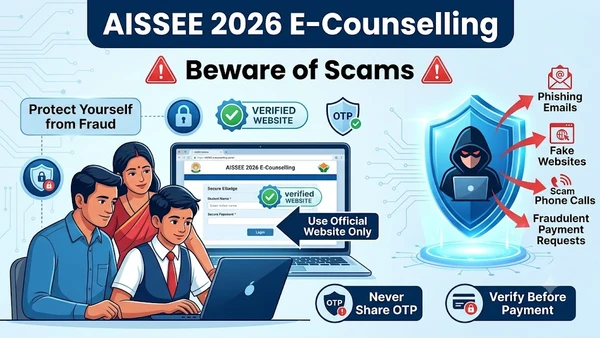
Your child qualified AISSEE. The relief was enormous. And then someone called.
They knew your child's name. They mentioned the exam. They said there were "limited seats" available and that they could secure one - for a fee. They sounded official. They had a website. They had a registration number. They said they were connected to the Sainik Schools Society.
Everything they said was designed to sound legitimate. None of it was.
Fraudsters targeting AISSEE families have been operating every admission season - and 2026 is no different. The targeting is sophisticated because the information they need is minimal: they know the AISSEE result date, they know parents are anxious, and they know the process is complex enough that many families don't know exactly what's supposed to happen next.
Here's what's real, what's fraud, and how to tell the difference.
The Official Position Is Unambiguous
The Sainik Schools Society has stated this clearly in official documentation for AISSAC 2026: the Sainik School admission ↗ e-counselling is free of cost. No third party has been authorised by the Sainik Schools Society for this purpose. Candidates are advised to be beware of fraudsters.
Three sentences. Everything you need to know.
Free of cost. No third party authorised. Beware of fraudsters.
If anyone - anyone at all - asks you to pay money for registration, seat allotment, category processing, document verification, or any other step in the AISSAC 2026 e-counselling process, they are committing fraud. There are no exceptions. There is no category of legitimate service provider that charges for any part of this process.
How the Scam Actually Works - The Pattern
Understanding the mechanism is the best protection against it. Fraudsters operating in the AISSEE space follow a recognisable pattern.
Step 1 - They find families in anxiety. The AISSEE result creates a window of vulnerability. Families who qualified know a seat depends on the counselling process. Families who scored on the borderline are especially anxious - they want assurance that their child will get a seat despite a mid-range rank. Fraudsters target both groups.
They operate in parent WhatsApp groups, in coaching institute networks, near exam centres during results season, and through social media advertisements. Some run websites that look nearly identical to the official AISSAC portal - same colour scheme, similar URL structure, legitimate-sounding content.
Step 2 - They create urgency. A scammer will tell you that seats are filling fast, that the registration window is closing today, that your child's category has very few seats left. All of this creates pressure to act now rather than verify first. Urgency is the most powerful tool in the fraud toolkit - it bypasses careful thinking.
Step 3 - They ask for money. Framed as a "processing charge," "category fee," "NTA coordination charge," "helpdesk access fee," or some other plausible-sounding label. Amounts range from a few thousand rupees to several lakhs depending on what the fraudster thinks the family will pay.
Step 4 - Nothing happens or the problem gets worse. The money is taken. Either the fraudster disappears entirely, or they produce fake documentation that eventually fails at the actual school, or they keep asking for more money to "fix" the next problem they've invented.
The Red Flags - What to Watch For Right Now
Any of these signals should stop you from engaging further:
Someone contacts you first. The official AISSAC process does not proactively contact families by phone or WhatsApp. Seat allotment, round results, and registration information are all communicated through the official portal - pesa.ncog.gov.in/sainikschoolecounselling - not through unsolicited calls or messages.
They ask for money at any stage. There is no fee for AISSAC registration. No fee for choice filling. No fee for seat allotment. No fee for category verification. The only official fee in the entire process is the small review fee - Rs 100 for General, Rs 50 for SC/ST - payable directly to a specific school if a candidate formally appeals a medical rejection. That fee is paid to the school, not to any third party or helpdesk.
The URL is not the official one. The official AISSAC portal URL is pesa.ncog.gov.in/sainikschoolecounselling. The official SSS website is sainikschoolsociety.in. Any other URL claiming to be an official AISSAC registration or counselling portal is fraudulent. Fake websites in 2026 are sophisticated - they look legitimate. Always check the exact URL, not just the page design.
They claim to "guarantee" a seat. No legitimate entity can guarantee an AISSAC seat. Seat allotment is purely based on rank, category, domicile, and school preference. Any claim of guaranteed admission in exchange for money is definitionally fraudulent.
They ask for your AISSEE roll number, application number, or password. Your AISSAC portal credentials should never be shared with anyone. Fraudsters who obtain your login details can access your counselling profile, change your school choices, or lock you out of the official process entirely.
Specific Fraud Types in the AISSEE Space
Fake Registration Portals
These are websites that mimic the AISSAC portal and ask families to "register" for counselling through their platform. They may collect application fees, personal data, and document uploads - all of which go to the fraudster rather than any official system. Families discover the fraud only when they log into the real portal and find no record of their registration.
Always register directly at pesa.ncog.gov.in/sainikschoolecounselling. Never through a link shared on WhatsApp, a Google advertisement, or a third-party education website.
Medical Round Fraud
As covered in our earlier blog on this topic - fraudsters specifically target families during the medical round, particularly those whose child received an unfit verdict. They claim to have "contacts" in the medical board who can change the outcome for payment.
No one outside the Review Medical Board can change a medical verdict. The only legitimate remedy for an unfit finding is a formal appeal supported by a certificate from a Government Specialist Doctor, submitted to the Principal within 15 days of receiving the unfit letter. This is free to pursue - the only official cost is the small review fee paid directly to the school.
Fake Helpline Numbers
Fraudsters operate fake AISSAC helpline numbers that appear in Google search results, often advertised as "AISSAC 2026 official helpdesk" or "NTA Sainik School helpline." Families who call these numbers receive official-sounding advice designed to eventually lead to a payment request.
Official contact for AISSAC: [email protected] and [email protected]. No phone helpline number for AISSAC counselling exists that is hosted independently of the official SSS channels. If a phone number claiming to be the official AISSAC helpdesk cannot be verified directly on sainikschoolsociety.in, don't trust it.
Seat "Reservation" Fraud
Some fraudsters claim to be able to "reserve" a specific school seat for a candidate - ahead of the official allotment rounds. This is impossible. Seat allotment is automated through the AISSAC portal based on rank, category, domicile, and school preferences. No human intervention can reserve or hold a specific seat outside that automated process.
If You've Already Been Targeted
If you've been contacted by someone you now suspect is a fraudster, take these steps immediately:
Don't pay. If payment hasn't happened yet - stop all contact with the person who contacted you.
Don't share credentials. If they've asked for your AISSAC portal login details - change your password immediately at pesa.ncog.gov.in and ensure your choices are still intact.
Report it. Email the incident to [email protected] and [email protected] with the phone number, website URL, or WhatsApp number used to contact you, the date and content of the communication, and any money transfer details if payment has already occurred.
File a police complaint. If money has been taken, this is a criminal fraud case. File an FIR with your local police station and also report it to the Cyber Crime portal at cybercrime.gov.in. These cases are prosecutable - the fraudster is committing criminal fraud, not just a civil dispute.
The Simple Rule That Protects You
Everything in the official AISSAC 2026 process is done through one portal: pesa.ncog.gov.in/sainikschoolecounselling. Everything is free. No phone call, no WhatsApp message, no third-party website, and no agent claiming connections to SSS, NTA, or any Sainik School is part of the official process.
If anyone asks you to do anything outside that portal or pay any money for any reason related to AISSEE 2026 counselling - it is fraud. Full stop.
Your child worked hard to qualify. The seat they earn belongs to them. Don't let a fraudster take it.