
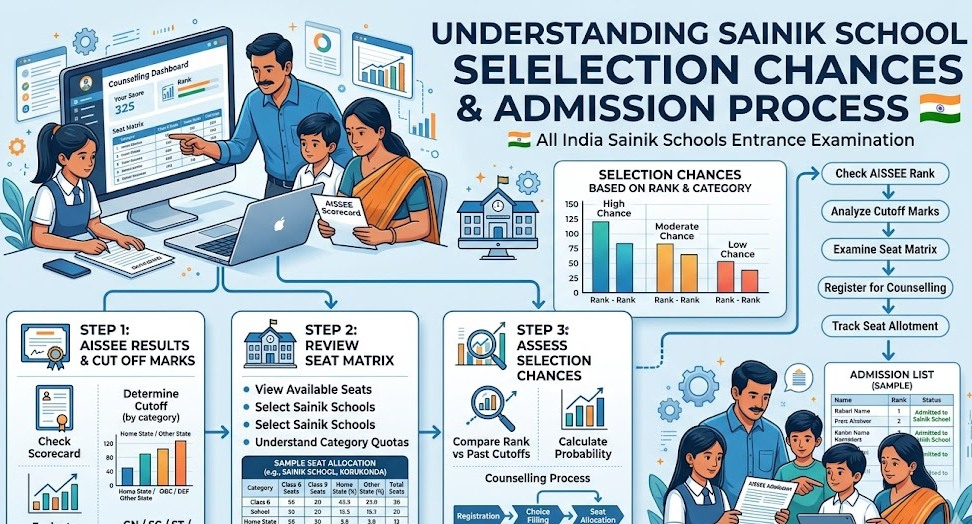
Your child's scorecard shows 218 marks in Class 6. Or 295 in Class 9. The question burning in your head is the same regardless of the number - which schools can this actually get us into?
Most parents approach this with gut instinct. They add popular schools because they've heard the names. They avoid unfamiliar schools because they don't know them. And they miss perfectly good seats at schools their score could comfortably have cleared - simply because nobody explained how to actually use the data that's sitting right there on the AISSAC portal.
Here's how to use it properly.
The Two Tools That Matter
Two things on the AISSAC portal give you everything you need to identify your child's realistic school options. Used together, they turn the choice-filling process from guesswork into a data-driven decision.
The Seat Matrix - shows how many seats exist at each school, broken down by class, gender, category, and domicile (home state or outside state).
The School-wise Cut Off - shows the minimum score at which seats were filled in each category at each school, released after each counselling round.
Candidates are advised to make a tentative list according to their preference of schools after going through the seat matrix uploaded on the AISSAC portal before choice filling and locking.
That's the official instruction. Follow it literally - not figuratively.
Step 1 - Access the Seat Matrix Before You Touch the Choice List
The seat matrix for all Sainik Schools and New Sainik Schools is live on the AISSAC portal.
Log into the portal at pesa.ncog.gov.in/sainikschoolecounselling with your candidate credentials. Find the seat matrix section. It's available before choice filling opens - which is exactly when you should be studying it.
The matrix shows you, for each school: total seats for Class 6 and Class 9 separately, gender split, category-wise breakdown - General, OBC-NCL, SC, ST, DEF - and home state versus outside state quota.
Pull up the schools you're considering. For each one, find the row that matches your child's profile: their class, their gender, their category, and their domicile status relative to that school.
That number - seats in your specific profile row - is the single most useful piece of information in the entire seat matrix. It tells you the size of the pool you're actually competing in at that school.
Step 2 - Understand What the Seat Numbers Tell You
More seats in your category means more chances of getting through. Fewer seats means a tighter competitive bar.
A school with 20 General category boys' seats for Class 6 in the home-state quota is considerably more accessible than a school with 4. Both are Sainik Schools. Both follow the same process. But at one of them, 20 of the highest-ranking home-state General boys get seats. At the other, only 4 do.
Seat allotment is based on the candidate's AISSEE ↗ rank, gender, category, and domicile. The system processes the candidate's school preferences in order and allocates the first school where a vacancy exists in their specific profile.
So if your child's rank places them at position 18 in the home-state General boys list for a school with 20 seats - they'll likely get it. The same rank at a school with 4 seats in that profile - no chance.
Check the seat matrix for this number at each school you're considering, for your exact profile. This single step will eliminate half your bad choices and reveal several schools you hadn't considered.
Step 3 - Use Previous Year Cut Offs as Your Benchmark
The seat matrix tells you how many seats exist. The cut off marks tell you what score it took to fill them last year.
The AISSEE 2026 cut off marks released on the official portal show the minimum scores at which seats were filled in each category at each school - released round by round after each allotment.
For 2026, use 2025 cut offs as your benchmark. These are expected ranges based on 2025 actuals. Official 2026 cut offs will be released on pesa.ncog.gov.in in March to April 2026.
Compare your child's marks against the previous year's cut off for their exact profile at each school. Not the General cut off if they're OBC. Not the outside-state cut off if their domicile matches the school's state. The specific row that matches their actual situation.
If their score sits comfortably above last year's cut off - good chance of getting through. If it's right at the cut off - borderline, and a safer backup is needed. If it's below - realistic chance is low, though later rounds sometimes bring cut offs down slightly as seats remain vacant.
Step 4 - Map Your Schools Into Three Groups
Once you've done the seat matrix check and the cut off comparison for 10 to 15 schools you're interested in, sort them into three buckets:
Aspirational - schools where your child's score is 5 to 15 marks below the expected cut off but the school is genuinely desired. One or two of these go at the top of the list. They're worth trying.
Realistic - schools where your child's score matches or slightly exceeds the expected cut off for their profile. These go in the middle slots - positions 3 through 6 or 7. This is where the actual seat will most likely come from.
Safety - schools where your child's score is well above the expected cut off, or schools with lower competition like New Sainik Schools or Northeast schools. These go in the lower slots - 7 through 10. New Sainik Schools require only 40% aggregate for all categories and generally have lower competitive cut offs than Old Sainik Schools. They're not a consolation prize. A seat here is a confirmed Sainik School seat.
After choosing preferences, the student has to click the Lock the Choices button. Various factors including rank, category, domicile, and gender are considered for seat allotment. The lock is the commitment. Make sure the mapping into these three groups is done before you lock - not after.
Step 5 - Apply the Domicile Filter First
Before anything else, every school needs to be filtered through domicile.
Every Sainik School reserves 67% of its seats for home state students and 33% for all-India quota. Home state applicants face lower competition, while all-India quota students face a higher bar.
For every school you're evaluating, ask one question first: is your child's domicile the same state as this school? If yes - use the home-state cut off and home-state seat count. If no - use the outside-state cut off and outside-state seat count.
The same score at the same school can be comfortably within range on the home-state cut off and far outside the outside-state cut off. This single filter changes your realistic school list more than any other factor.
Families often make the mistake of comparing against whichever cut off they found first on a website. Make sure it's the right one for your child's domicile situation at each specific school.
Step 6 - Check the Vacancy Pattern in Later Rounds
Here's something experienced families use that most first-timers miss.
The school-wise cut off is released after each counselling round. In earlier rounds, cut offs are at their highest - only the strongest ranks get allocated. In later rounds, as candidates reconsider, exit, or fail medicals, remaining seats are redistributed. Cut offs often dip slightly in rounds 3 and 4.
A step-by-step video tutorial for candidates on how to undertake prioritisation and choice filling of schools is available on the AISSAC portal. The seat matrix for all Sainik Schools and New Sainik Schools is live on the portal for reference.
Watching the round-wise cut off movement tells you whether a borderline school is trending toward your child's score or away from it. A school that was 8 marks above your child's score in Round 1 and 4 marks above in Round 2 may reach your child's range by Round 3. That's a school worth keeping in your active list.
What to Do When You Can't Find the Cut Off Data
Not every school's historical cut off is easily searchable online. Some schools are newer to the AISSEE process and limited prior data exists.
For those schools - use the seat matrix as your primary guide. More seats in your category signals lower competition. Cross-reference with state-level competition data: schools in less competitive home states typically have softer cut offs regardless of whether historical data is available.
Further, candidates are advised to carefully read and understand the SOP for AISSAC and FAQs before the start of online registration and choice filling. The SOP itself contains guidance on how seat allocation priorities work - reading it once gives you a framework for judging any school even without historical cut off data.
The seat matrix and cut off data are publicly available tools. Every family applying to AISSEE 2026 has access to the same information. The ones who use it methodically - school by school, profile by profile, domicile by domicile - make better choices. The ones who fill the portal by instinct leave seats on the table that their child's score could have captured.