Your child has worked hard all year. The AISSEE result came out and they qualified. Now comes something families consistently underestimate - the Sainik School medical test.
Every admission season, seats that were practically confirmed get cancelled at the medical round. Not because of bad luck. Because families assumed their child was healthy enough without actually checking the specific parameters doctors use.
The medical test isn't a general health check. It's a structured fitness assessment with defined pass-fail criteria. Preparation for it is different from exam preparation - but it's just as important.
Here's how to approach it properly.
Start With the Eye Test - Right Now
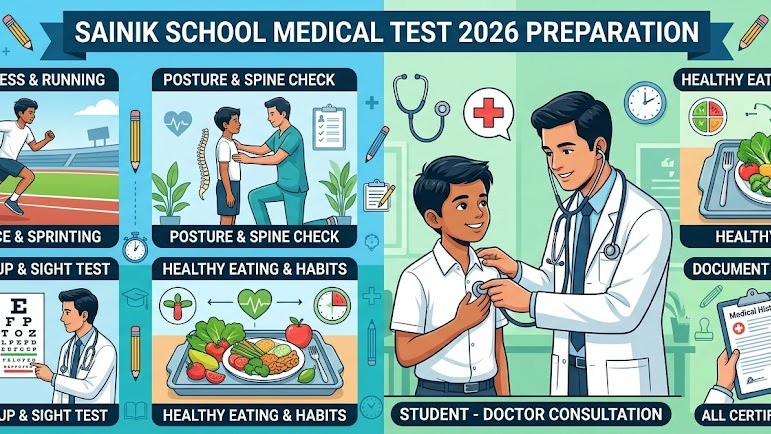
Vision is the single most common reason for medical rejection at Sainik School examination. And it's the most preventable - if you act early enough.
The minimum acceptable visual standard for Sainik School admission ↗ is: distant vision in the better eye at 6/18 and worse eye at 5/18, correctable to 6/16 and 6/19. Myopia must not exceed minus 1.5 including astigmatism.
Minus 1.5. That's the limit. Not minus 2.0. Not minus 2.5. If your child wears glasses and the prescription is anywhere near minus 1.0 or beyond - get a proper ophthalmologist assessment this week.
Don't go to a spectacle shop for this. Go to a government ophthalmologist or a qualified eye hospital and get a full refraction test, including astigmatism values. You need exact numbers, not rough estimates.
Candidates with squint, colour blindness, or night blindness are declared unfit at the eye examination stage. If there's any family history of colour blindness - especially in boys - get a formal colour vision test done before the medical date.
If your child's eye power is near the acceptable boundary, consult an ophthalmologist well in advance - not the week before. Early identification gives time to explore whether there are corrective options available.
Check for Flat Feet and Knock Knees
Knock knees and flat feet are not eligible for admission to Sainik School. Both are examined specifically during the bone and joint assessment.
Flat feet - the absence of a normal foot arch - is something many parents don't notice in daily life because children rarely complain. Look at your child's footprint on a wet surface. A full flat print without any arch indicates pes planus. Have an orthopaedic specialist assess it formally.
Knock knees - where the knees angle inward when standing - can be assessed by standing your child with feet together and checking whether the knees touch before the ankles do. A formal orthopaedic measurement is the reliable way.
If either condition is present, consult an orthopaedic specialist immediately. Some mild cases of flat feet respond to exercises and corrective footwear over time. This takes months - which is why you need to start now, not after the medical call letter arrives.
Maintain Healthy Weight - This Is Within Your Control
The candidate must show no signs of poor physical build, underdevelopment, major deformities, or obesity. Body weight must remain within the maximum limit specified in the standard height-weight chart for ages 10-11 years for Class 6 and 13-14 years for Class 9.
Many children spend six months in intense exam preparation - sitting, studying, skipping outdoor play. Weight creeps up without anyone noticing. Then the medical test flags it.
Physical fitness preparation starts months before medical day - not the week before. Maintaining daily physical activity throughout exam preparation keeps weight proportionate and fitness levels acceptable.
The practical fix is not complicated. Thirty to forty-five minutes of outdoor physical activity daily - running, cycling, outdoor games - is enough to keep weight proportionate and physical fitness at an acceptable level. This doesn't interfere with study time if planned properly. It actually improves focus and sleep, which helps the study too.
Check your child's weight against a standard age-height weight chart right now. If there's a gap - address it over the next few months with regular activity and a sensible diet.
Get an ENT Check Done
There must be no impaired hearing, discharge from or disease of either ear, unhealed perforation of the tympanic membranes, or signs of acute or chronic suppurative otitis media.
If your child has had any history of ear infections, ear pain, or discharge - get a formal ENT assessment. A simple otoscopy by an ENT specialist will confirm whether the eardrum is intact and healthy.
A soundly healed perforation without any impairment of hearing should not be a reason for rejection - but an active or chronic perforation is a disqualifying condition. The difference matters. Know which situation applies to your child before the examination day.
For nose and throat - if your child has chronic sinusitis, recurring tonsil issues, or nasal polyps, have them assessed and treated well in advance. Active ENT conditions on examination day are flagged. Treated and resolved conditions with documented medical history are assessed differently.
Watch for Speech Issues
The candidate must not have any speech difficulties such as stammering or other noticeable speech defects.
This one surprises many families because speech isn't routinely tested in school. But during the medical examination - as doctors ask questions, take history, and interact with the child - speech patterns are naturally observed.
If your child has any tendency to stammer - particularly under stress or when speaking quickly - address it early. A speech therapist can work on stammering effectively over a period of months. This is something that takes consistent practice, not a last-minute fix.
If the stammering has significantly improved but isn't fully resolved, carry documentation from a speech therapist confirming the progress and current status. Contextual evidence helps the examining doctor assess the situation accurately.
Prepare the Documents Before the Medical Date
The preparation for medical day isn't just physical. The documentation requirement is specific and missing even one item can cause problems.
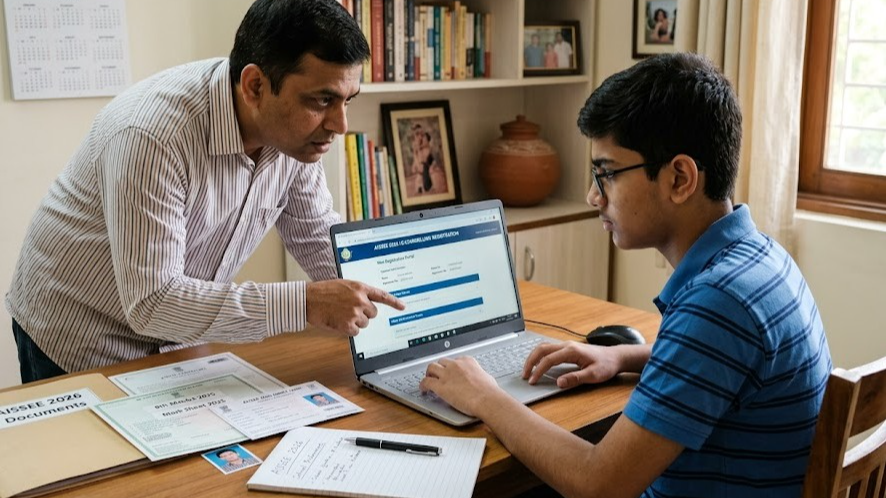
Candidates must bring three sets of the medical form - available on the AISSAC portal under List of Documents - along with the AISSEE Admit Card, AISSEE Score Card, Aadhaar card of the candidate, Date of Birth Certificate, and Aadhaar cards of both parents. All originals and self-certified copies are required.
Print the medical form well in advance. It is 15 to 16 pages long. You need three complete sets. Don't leave printing to the night before.
If your child has any known medical condition - treated or ongoing - compile the relevant documents now. Specialist clearance letters, surgical records, diagnostic reports. Carry them even if you think they won't be needed. Having them available gives the examining doctor context. Not having them when they're needed is a different problem entirely.
On the Morning of the Medical Examination
Report at 0800 hours on the scheduled date. Late arrival results in disqualification from the counselling process. Arrive early, not on time.
Your child should be well-rested the night before. A tired, anxious child doesn't present as physically and mentally well as one who slept properly. Don't schedule a late-night drive that leaves the family exhausted on arrival.
Eat a normal breakfast - not a heavy meal, not skipping entirely. Ensure your child is hydrated. Basic urine tests are part of the examination and hydration affects readings.
Don't coach your child to hide anything. If a doctor asks about medical history and your child has been told to deny a known condition - and that condition is then discovered during examination - the situation becomes far more serious than a straightforward disclosure would have been.
If the Unexpected Happens - You Still Have Options
Even with careful preparation, borderline findings happen. A reading that was at the acceptable limit in a clinic tests slightly outside it on examination day. Circumstances like these exist and the system has an appeal mechanism precisely because of them.
Parents have 15 days from receiving the unfit letter to appeal to the Principal of the school. Any appeal must be supported by a medical certificate issued by a Government Specialist Doctor who has reviewed the school's rejection letter and examined the child with specific attention to the flagged condition.
Know this process exists. If something unexpected happens at the medical examination - don't assume it's final. Act immediately within the 15-day window.
Preparation for the medical test isn't about gaming the system. It's about making sure a child who is genuinely healthy and fit isn't caught off guard by a condition that could have been identified and addressed months earlier.