
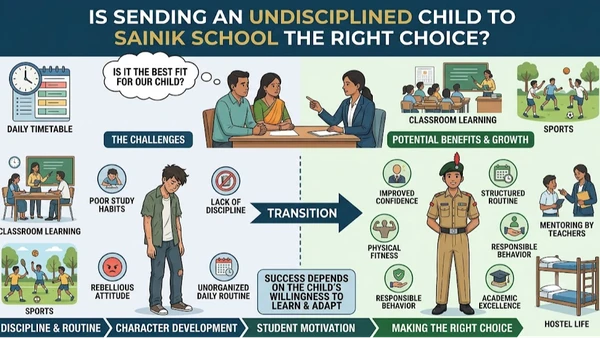
This conversation happens more often than anyone in the Sainik School community likes to admit.
A parent sits with a child who won't wake up on time, refuses to study, argues about everything, can't sit still for twenty minutes, and generally makes home life exhausting. And the parent thinks - if only someone could put some structure into this child. Sainik School would sort him out.
Sometimes this reasoning is exactly right. Sometimes it's the wrong call for the wrong reasons and it ends within the first term when the child is brought home after struggling badly.
Here's the honest breakdown of when Sainik School discipline actually works on a child who isn't naturally disciplined - and when it doesn't.
What Sainik School's Discipline System Actually Does
This structured Sainik School lifestyle helps students develop time management, confidence, leadership and self-discipline - skills that prepare them for NDA, defence careers and success in any field.
The discipline at Sainik School is not punishment-based. It's environment-based. The system works by removing choice. There's one schedule. Everyone wakes at the same time, eats at the same time, studies at the same time, plays at the same time. There's no option to negotiate, no path around the routine, and no personal schedule that competes with the institution's.
Foster discipline: Sainik Schools thrive on discipline. Hence, encourage good habits and routines at home. Promote physical fitness: regular exercise and a healthy lifestyle are crucial. Develop mental fortitude: the demanding environment requires resilience. Encourage your child to face challenges with a positive attitude.
For a child who is undisciplined because nobody has ever imposed a consistent structure on them - this environment can be genuinely transformative. The school doesn't reform the child through lectures or punishments. It reforms them by making discipline the only available option, consistently, every single day.
The peer environment reinforces this. Every other child in the dormitory is navigating the same routine. There's no social reward for resisting it - the culture is one of collective compliance with the schedule. A child who wants to fit in, who is socially aware, and who isn't deeply resistant to authority will often adapt within the first two terms.
The Child Sainik School Works Well For
There's a profile of "undisciplined child" that Sainik School handles remarkably well.
The child who is bright, energetic, and easily bored in regular school. The child whose discipline problems come from under-stimulation - too much unstructured time, too little challenge, too few consequences. The child who argues about bedtime but wakes up fine when the environment removes the argument entirely. The child who is physically active, socially confident, and fundamentally willing to accept authority when they respect the people imposing it.
Each Sainik School emphasises discipline, teamwork, leadership, and character development, offering a holistic blend of academics, physical training, and extracurricular activities.
This type of child - energetic, capable, resistant only to inconsistent civilian parenting - often thrives at Sainik School in ways that genuinely surprise their parents. The same child who couldn't wake up at 8 AM at home is up at 5 AM on the parade ground by week three, and doesn't find it punishing because everyone around him is doing the same thing.
The physical training component helps this profile specifically. A child with excess energy and restlessness finds constructive release in daily PT, sports, and physical activity. The boredom that drove difficult behaviour at home disappears in an environment that genuinely keeps children physically and mentally occupied from before dawn to after dark.
The Child Sainik School Struggles to Help
There's also a profile that the Sainik School environment doesn't work well for - and parents who send children in this category without recognising it create real problems.
The child with genuine anxiety or emotional regulation difficulties. For a child whose difficult behaviour comes from anxiety rather than boredom - a sudden residential separation from family at age 10 or 11, combined with an intensely structured military-pattern environment, can make the underlying anxiety significantly worse rather than better. The school is not equipped to provide the kind of therapeutic support an anxious child needs. It provides structure. For anxiety, structure without emotional support doesn't heal - it suppresses, and what gets suppressed often comes out in harder-to-manage ways.
The child with a developmental difference that hasn't been diagnosed or addressed. Some children who appear "undisciplined" are actually dealing with ADHD, processing difficulties, or sensory sensitivities that make a regimented military-pattern environment particularly challenging. These children need specialist support, not institutional discipline.
The child who is genuinely resistant to authority at a deep level - not performatively, but fundamentally. Some children respond to external authority with escalation rather than compliance. The Sainik School environment, with its consistent consequences and collective expectations, generally works. But for a child who pushes back harder when pushed - this environment can create conflict rather than compliance.
The child whose parent wants the school more than the child does. This might be the most important category of all. A child who has been told they're being sent to Sainik School to be "fixed" - who carries that framing into the environment - is starting at a disadvantage. The motivation required to get through the hard first term has to come from somewhere. Children who joined because they genuinely wanted to be there, who had some internal aspiration to be part of this kind of school, find that motivation in the culture itself. Children who were sent to be corrected often find none.
What the Research and Reality Tell Us
Sainik Schools are generally considered safer and more disciplined than regular hostels. These schools are specifically designed to provide a secure and structured environment for students while focusing on their academic, physical, and moral development. Supervision by trained staff and wardens ensures constant supervision of students. Strict rules and regulations minimize the chances of misconduct.
The school provides structure. It doesn't provide therapy. It builds discipline through environment and expectation. It doesn't diagnose or address the underlying cause of a child's difficult behaviour.
If the cause of your child's discipline problems is environment - too much freedom, too little structure, inconsistent parenting - Sainik School can be transformative.
If the cause is something deeper - anxiety, developmental difference, family trauma - Sainik School is not the right intervention. It's a school, not a treatment.
The Questions to Answer Before Deciding
Before applying to Sainik School on the basis of a discipline concern, answer these honestly:
Does your child have any interest in military life, NDA, or defence careers - or does that aspiration exist only in the parent?
Has your child ever responded well to any form of consistent structured environment - a sports programme, a summer camp, a strict teacher - or does authority consistently escalate conflict?
Is the behaviour that concerns you driven by boredom and under-stimulation, or by something that has persisted across multiple environments regardless of structure?
Has your child ever spent extended time away from home - even briefly - and how did they manage?
If the honest answers suggest a child who is energetic, capable, and structurally under-managed - Sainik School may be exactly right. If they suggest a child who is anxious, deeply resistant, or dealing with something that needs professional attention - address that first, and consider Sainik School as a later option when the underlying situation is more stable.
Sainik School admission ↗ demands that parents prepare the child for the holistic demands of a Sainik School. Developing mental fortitude - the demanding environment requires resilience.
Sainik School builds resilience. It doesn't create it from nothing. A child who already has some - who has shown they can navigate difficulty without total collapse - has what they need to grow significantly in that environment. A child who has never had to navigate difficulty without parental rescue needs something different first.
For honest Sainik School admission guidance and complete AISSEE preparation support, visit SainikGuru.com.