
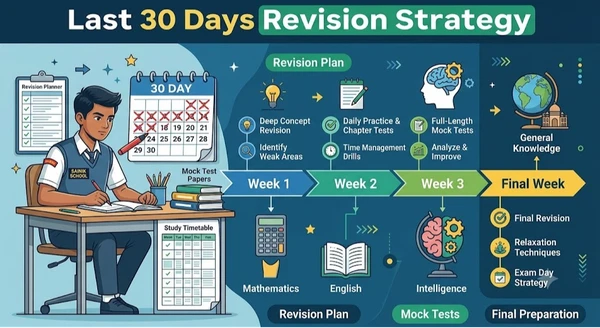
The last 30 days before AISSEE ↗ feel different from every other part of preparation. The syllabus is mostly done. The mock tests have been running. And now there's this uncomfortable question: am I doing enough? What should I be doing right now?
Two common mistakes happen at this stage. Some families panic and try to restart the entire syllabus - racing through chapters at a pace that doesn't actually fix anything. Others coast through the final month doing light revision and not enough exam practice, arriving on test day rusty and unsharp.
The right approach sits between both. Strategic. Focused. Built around mock tests and targeted revision - not full syllabus repetition.
Here's the day-by-day plan.
The Mindset Before the Plan
The last 30 days are not for learning new topics. That window has closed.
Revision is one tip from the toppers' strategy. They go through the topics they have studied to get a strong hold on the subject. Toppers plan a set of revisions before the exam.
Revision in this phase means: revisiting what's already been studied, practising it under exam conditions, and filling the specific gaps that mock tests have revealed - not starting fresh chapters that haven't been touched.
If a topic appears in the final month that was genuinely never studied during the preparation year - skip it. The time cost of learning it from scratch now is higher than the marks it's worth. Focus on consolidating what's already there.
Week 1 - Days 1 to 7: Subject Consolidation
The first week is for going back through weak spots identified across the preparation period.
Pull out the error notebook from all the mock tests taken over the past months. Look at which subjects and which specific topics produced the most consistent errors. Those are the Week 1 priority.
Mathematics: Revisit the 3 to 4 topics that produced the most wrong answers across mocks. Don't re-read - solve. Take 15 to 20 targeted problems on each weak topic. Time them. Prioritize high-weightage sections like Mathematics during preparation.
Intelligence: Take sectional Intelligence practice sets - 20 questions, 15 minutes, reviewed carefully. Do this every day in Week 1. Intelligence improves fastest with daily targeted practice in the final stretch.
GK: Revise from short notes - it is more comfortable than carrying heavy books. Use the GK notebook built during preparation. 20 minutes of daily GK note review, covering static GK one day and current affairs the next.
Language/English: Grammar rules - tenses, prepositions, sentence correction - revise once from notes. Focus the rest of Week 1 English time on comprehension practice. Speed reading with accurate understanding is what the Language section tests.
No full-length mock tests in Week 1. Just targeted subject revision.
Week 2 - Days 8 to 14: Mock Test Intensive
Week 2 is the heaviest mock test week of the final month.
Students should give at least 5 mock tests at some intervals and make improvements. If you haven't reached that number yet, this week closes the gap. If you're already past 10 or 15 mocks - you're continuing the rhythm.
Schedule for Week 2:
- Day 8: Full-length mock test, timed strictly
- Day 9: Complete review of Day 8 mock. Error notebook updated. Target chapter revision based on errors.
- Day 10: Subject practice on weak topics identified from Day 8 review
- Day 11: Full-length mock test, timed strictly
- Day 12: Complete review of Day 11 mock. Error notebook updated.
- Day 13: GK revision + Intelligence sectional practice
- Day 14: Light revision day - no mock test, no new content. Just error notebook review and formula/concept sheet revision.
The review days are not optional. Self-evaluation through answer keys and analysis of performance enables the student to find weak areas and work on them before the final exam. The improvement from one mock to the next comes from the review day between them - not from the tests themselves.
Week 3 - Days 15 to 21: Speed and Accuracy
By Week 3, the focus shifts from what you know to how fast and accurately you can apply it.
Practice mental math to improve speed and accuracy.
Mathematics speed drills: Set a timer for 30 minutes. Solve 25 Mathematics questions from previous year papers. Check accuracy and count how many were completed. The goal is to reach a point where 50 Mathematics questions can be attempted comfortably within 55 to 60 minutes with high accuracy.
Section timing practice: Take sectional timed mini-tests rather than full mock tests on most days this week. 25 GK questions in 20 minutes. 25 Intelligence questions in 18 minutes. 25 Language questions in 22 minutes. This sharpens speed in each section individually.
Two full-length mocks this week: One in the first half, one in the second half. Review both. The score from these two mocks is a reliable predictor of actual exam performance - not because mock scores perfectly predict AISSEE scores, but because the gap between these and your child's target score tells you exactly where the remaining days need to go.
Students are advised to revise the covered syllabus at regular intervals to stay updated with important facts.
Week 4 - Days 22 to 28: Final Consolidation
Week 4 is where many families make the biggest mistake - either cramming desperately or doing almost nothing. Neither works.
Days 22 to 25: One full-length mock every other day, reviewed the same day. In between mock days - only light revision from notes and error notebook. No new chapters. No new workbooks.
Days 26 to 28: No full-length mocks. Just light revision.
Make handwritten notes, which will help you to understand the topics easily. Revising from short notes is more comfortable than carrying heavy books. These three days are for formula sheets, key GK facts, grammar rules, and the error notebook - quick passes through everything already known, not deep dives into chapters.
Maintain a healthy routine with adequate sleep and exercise to stay focused. Sleep is not a luxury in Week 4. A child who sleeps 5 hours and studies 7 more will perform worse on exam day than one who sleeps 8 hours and does 3 focused hours of revision. Sleep consolidates memory. It processes what was studied. It is part of the preparation.
Physical activity matters too. 20 to 30 minutes of outdoor movement daily keeps anxiety manageable, focus sharp, and mood stable. Sitting 12 hours a day in the final week produces anxiety, not performance.
Days 29 and 30 - The Final 48 Hours
Day 29 is for light revision only. Formula sheet, GK notebook, error notebook. One last pass. No mock tests. No new practice sets.
Students must practice previous year papers and revise as much as possible. If there's an urge to take one more mock on Day 29 - redirect it. A mock test 24 hours before the exam doesn't improve scores. It consumes mental energy that should be arriving fresh at the exam hall.
Day 30 is exam day.
Arrive early. Carry the admit card, pencils, eraser, sharpener, water. Eat a normal breakfast - not too heavy, not skipping. Sleep the night before at a regular time. Don't try to pull an all-nighter.
In the exam hall: attempt every question. There is no negative marking for unanswered questions or incorrect responses. A blank is guaranteed zero. Follow the section timing plan that was practised across 20-plus mocks. Don't let one hard Mathematics question consume 8 minutes - move on, come back if time allows.
The child who walks into AISSEE 2026 having taken 20-plus mock tests under exam conditions, reviewed each one carefully, and spent the final month on targeted revision and speed - that child has done everything that is within their control.