
When parents first hear about the two routes for New Sainik School admission ↗, the reaction is usually the same. "Two routes? What does that even mean?"
It's a fair question. And it matters practically, because which route applies to your child determines how they compete for NSS seats - and whether the domicile and category reservations that govern Old Sainik School admissions even apply to them at all.
Here's the complete explanation.
Why Two Routes Exist
New Sainik Schools operate under a Public-Private Partnership model. Many of these schools existed before they became approved NSS institutions - they were already running as private or state-aided schools with their own enrolled students.
When the Sainik School Society brought these institutions into the AISSEE framework, they faced a practical question: what happens to the students already enrolled in these schools who want to transition into the Sainik School stream? Forcing them all to compete on a national merit list against new applicants didn't make sense. But filling all seats from internal students wasn't fair to external AISSEE candidates either.
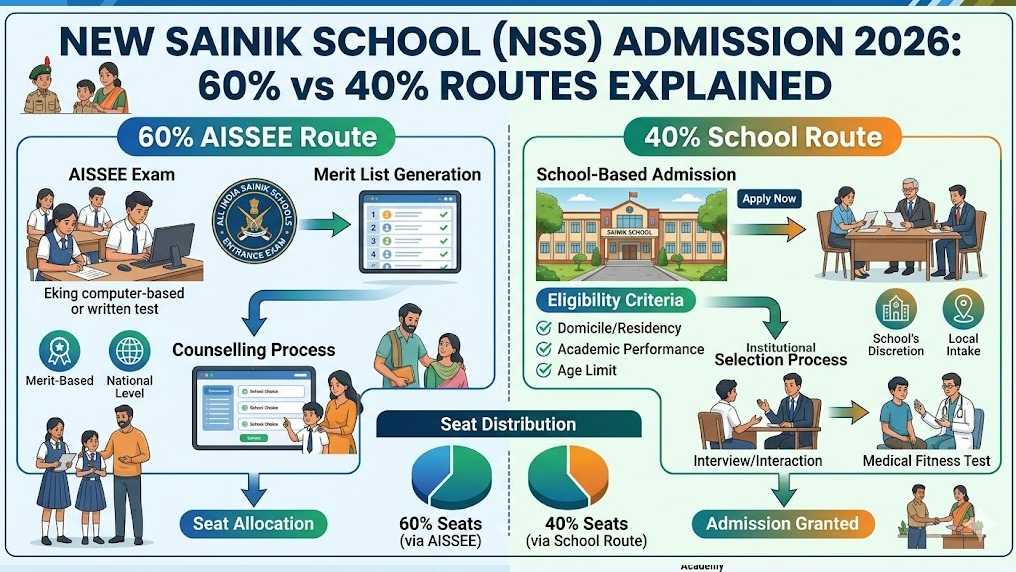
The solution was a dual admission route: a minimum of 40% of seats filled through the All India Merit List of AISSEE - open to all external candidates - and up to 60% of seats reserved for students already studying in that specific approved New Sainik School, filled through the school-wise merit list.
Two routes. Two different pools of candidates. Two different merit lists. Same entrance exam.
The 40% Route (Category A) - For External Candidates
This is the route that applies to most families whose child appeared in AISSEE 2026 without already being enrolled in a New Sainik School.
A minimum of 40% of the seats under the Sainik School stream in approved New Sainik Schools will be filled based on the rank secured in the All India Merit List of AISSEE 2026. Domicile or category are not considered for this merit list.
That last sentence is critical. No domicile. No category reservation.
Unlike Old Sainik Schools - where 67% of seats go to home-state students, where SC/ST/OBC-NCL/DEF sub-reservations apply, where a General category candidate from outside the state competes in a narrow 33% pool - none of that exists in the NSS 40% route. It is pure national merit. Your AISSEE rank versus every other external candidate who applied to that school. Nothing else.
Who is eligible for the 40% route:
For Class 6, Category A applicants must be between 10 and 12 years old as of March 31, 2026, born between April 1, 2014 and March 31, 2016. Applicants of all genders are welcome to apply. For Class 9, Category A applicants must be between 13 and 15 years old as of March 31, 2026, born between April 1, 2011 and March 31, 2013. They should have passed Class 8 at a recognised school.
Essentially - any AISSEE 2026 qualifier of the right age and class who did not attend an approved New Sainik School can apply through this route. The AISSAC portal handles the seat allocation automatically based on your AISSEE rank.
Candidates can opt for any approved New Sainik School in India at the time of Sainik School e-counselling under the 40% route. There's no geographic restriction. You don't need to be from the state where the NSS is located. A family from Karnataka can apply to an NSS in Haryana. No domicile filter applies.
The 60% Route (Category B) - For Internal NSS Students
This route is for a specific, narrower group - children who are already enrolled as students in an approved New Sainik School and want to continue in the Sainik School stream within that same institution.
Up to 60% of the seats in New Sainik Schools will be filled by those who are currently studying in any of the approved New Sainik Schools. They are filled based on rank secured in the school-wise merit list of AISSEE. Domicile or category are not considered for this merit list either.
Candidates are deemed to have opted for the approved New Sainik School where they are currently studying - as indicated in their AISSEE application form - for admission under this route.
This means the school-wise merit list for the 60% route is automatically compiled by the AISSAC system based on the school you declared as your current school during NTA registration. You don't separately apply for the 60% route. The system identifies internal candidates from registration data and places them in the school-wise merit list automatically.
Who is eligible for the 60% route:
For Class 6 Category B, students must be within the 10 to 12 age range as of March 31, 2026, and must be currently enrolled in or graduated from Class 5 at the specific approved New Sainik School where they are seeking admission in the Sainik School vertical. For Class 9 Category B, students must have completed Class 8 at a Sainik School.
The defining requirement is current enrollment at that specific approved NSS. Not at any NSS - at the one you want to continue in.
What Happens When 60% Seats Go Unfilled
This is an important backstop that many parents don't know about.
In cases where a school is unable to fill its seats with Category B students who are already enrolled, the vacancies will be filled by drawing candidates from the 40% All India Merit List.
So if an NSS doesn't have enough internal students who appeared in AISSEE and qualified, those unfilled 60% seats flow into the external 40% pool. In practice, this means external candidates at schools with fewer internal students get access to more than just 40% of seats. The actual proportion available to external applicants can exceed 40% - sometimes significantly - depending on the school.
This also means the official "40% seats" figure is a minimum guarantee, not a ceiling. If you're applying to a newer NSS with a smaller enrolled student base, the realistic external seat count may be closer to 50% or 60% of total seats.
How the AISSAC Portal Treats Both Routes
From the AISSAC portal perspective, external candidates choosing New Sainik Schools on their 10-choice preference list are automatically considered under the 40% route. The system pulls from the All India Merit List.
Internal candidates - those whose registered school during NTA application is an approved NSS - are automatically considered under the 60% route for that school's internal merit list. They can also add other schools to their AISSAC preference list for the 40% external route at those schools.
Students can apply for traditional Old Sainik Schools, NSS under the 40% route, or NSS under the 60% route depending on eligibility. If your child is not in a New Sainik School yet, they can still apply for both traditional Sainik Schools and New Sainik Schools under the 40% external route.
This means a child who is not currently in any NSS can add multiple NSS schools to their AISSAC choice list alongside Old Sainik Schools. The portal treats the NSS entries as 40% route applications automatically. No additional step needed.
Minimum Qualifying Marks for NSS
The qualifying bar at New Sainik Schools is slightly different from Old Sainik Schools.
For admission in New Sainik Schools through both 40% and 60% routes, the minimum qualifying marks are 25% in each section and 40% in aggregate. This minimum does not apply to SC/ST categories.
The aggregate minimum of 40% applies across categories - lower than the 45% required for General category at Old Sainik Schools. This makes NSS admission through the 40% route accessible to a broader range of AISSEE qualifiers, particularly those who scored in the 165 to 200 range for Class 6.
Which Route Is More Competitive?
This depends on the school. At a well-established NSS with a large enrolled student base, the 60% route is heavily competed - many internal students appeared in AISSEE and ranked well. The school-wise merit list for the 60% route at such schools can be quite tight.
At newer NSS schools still building their enrolled base, the internal competition in the 60% route is lower. And because unfilled 60% seats flow to external candidates, the effective external opportunity is larger.
For external candidates applying through the 40% route - the competition is national, category-blind, domicile-blind. A strong AISSEE rank is the single deciding factor. Candidates who scored well but fall slightly below the competitive cut off for Old Sainik Schools in their category often find the NSS 40% route more accessible because the playing field is level and doesn't disadvantage them for being from a particular state or category.
What to Do With This Information
If your child is not currently enrolled in any NSS - they apply through the 40% route. Add New Sainik Schools to your AISSAC choice list. The portal handles the rest.
If your child is currently enrolled in an approved NSS - they're automatically considered under the 60% route at that school. Additionally, they can add other schools - Old Sainik Schools or other NSS schools - to their preference list for the 40% external route.
In either case: check the specific NSS's official website for whether it is genuinely residential, CBSE-affiliated, and running an active physical training programme before accepting any allotment.