
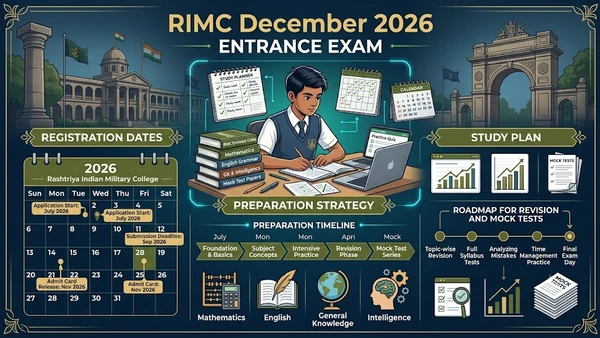
Most families who missed the June 2026 RIMC cycle are now looking at December. And honestly, for many states, the December cycle offers a second chance that's worth taking seriously.
RIMC conducts the exam twice a year - June and December sessions. If you missed the April deadline for the June exam, your focus should now shift to the December cycle.
The December 2026 exam leads to admission for the July 2027 term at RIMC Dehradun. The preparation window available between now and December is actually a meaningful one - enough time to build genuine readiness, not just cram.
Here's everything you need for the December 2026 cycle, from registration to exam day.
What RIMC Is - And Why December Matters
The Rashtriya Indian Military College is a Category 'A' Training Establishment under the Ministry of Defence. Established in 1922, it serves as a feeder institution for the NDA and the Indian Naval Academy. Admission is granted only for Class 8, and the college now welcomes both boys and girls.
Because of the limited seats - usually one per state - the exam doesn't just test your child's knowledge; it tests their stamina, personality, and psychological readiness.
That last line matters. One seat per state is the approximate scale. That's the level of competition families are entering. It's not impossible - RIMC has been producing Army Chiefs, Naval Admirals, and Air Marshals for over a century - but it requires preparation that goes beyond textbook coverage.
December 2026 Registration Dates
The exam is conducted twice a year - June exam for January session admission, and December exam for July session admission. Students can attempt both in different years until the age limit is crossed.
For the December 2026 cycle specifically, the registration process follows a predictable pattern. The June 2026 exam was held on 4 June 2026. For 2026, the first half of the year has already seen the notification and application phases for the June exam. If your child is targeting the upcoming December 2026 exam, you need to start preparing your documents and your study plan immediately.
Based on official RIMC patterns, the December 2026 exam notification typically releases around August or September 2026. Application forms and the prospectus are made available simultaneously. The exam itself follows in December - the specific date for December 2026 has not been officially confirmed yet. Always verify the exact date from the official RIMC website at www.rimc.gov.in as the notification drops.
What is confirmed: the RIMC Chronicle March 2026 is available on the official site, and the All India Merit List for the December 2025 exam for the term commencing July 2026 has been published - confirming the cycle is live and the December 2026 notification will follow the same established pattern.
Eligibility for RIMC December 2026
Candidates must be between 11½ and 13 years of age on the first day of the session - January 1 or July 1. For the January 2027 session, candidates must be born between July 2, 2013 and January 1, 2015.
For the July 2027 session - which the December 2026 exam feeds into - the age window shifts accordingly. Candidates born between approximately January 2, 2014 and July 1, 2015 would typically be eligible for the July 2027 term. Confirm the exact birth date range from the official RIMC notification for the December 2026 cycle.
The candidate must be studying in Class VII or have passed Class VII from a recognised school at the time of joining.
Both boys and girls are eligible for RIMC entrance exam. Girls have been eligible since recent years.
The Application Process - What's Different About RIMC
This catches families off guard every cycle. RIMC does not use a centralised online portal the way AISSEE or even RMS does. The application route is different.
The prospectus-cum-application form and booklet of old question papers can be obtained from the Rashtriya Indian Military College, Garhi Cantt, Dehradun, Uttarakhand Pin Code 248003 through Speed Post by forwarding a self-addressed slip and an account payee Bank Demand Draft.
The prospectus-cum-application form must be obtained from RIMC Dehradun via Speed Post or online payment at rimc.gov.in and then submitted to your State Government. The fee is Rs 600 for General category candidates and Rs 555 for SC/ST candidates. Payment is made via Demand Draft in favour of 'THE COMMANDANT RIMC FUND' payable at HDFC Bank, Ballupur Chowk, Dehradun.
Application forms are to be submitted to the respective State Governments. This is the step most families get wrong - submitting directly to RIMC Dehradun instead of to their state government's designated office. The official RIMC guidelines specify the correct state-wise submission addresses. Find this information specifically in the prospectus for the December 2026 cycle.
Documents required with the application: two passport-size photographs, domicile certificate of the candidate, birth certificate issued by Municipal Corporation or Gram Panchayat, SC/ST certificate if applicable, and certificate from the principal of the school in original with photograph, attested, stating date of birth and the class the candidate is studying in.
The Exam Pattern - What Makes RIMC Different
This is the most important thing to understand before starting preparation. RIMC is not a multiple-choice exam. The exam has both descriptive - essay-type - and objective components, unlike most school entrance exams which are MCQ only.
Candidates are selected on the basis of their performance in an All India Entrance Examination comprising a written examination of question papers in English - 125 marks - Mathematics - 200 marks - and General Knowledge - 75 marks. Successful candidates are called for a Viva-Voce test of 50 marks.
Minimum 50% marks are required in each of English, Maths, and GK separately to qualify for interview. Mathematics and GK papers can be answered in Hindi or English; the English paper is in English only.
That 50% minimum in every individual subject is the structural challenge most families underestimate. A child who scores 80% in Mathematics but 48% in English is eliminated - regardless of the overall aggregate. Balance across all three subjects is not optional.
The Viva Voce oral examination consists of 50 marks, designed to assess a candidate's intelligence, personality, and confidence. The minimum passing marks will be 50%.
After the viva voce: all the candidates, qualified after interview, will undergo a medical examination at selected Military Hospitals, and only those candidates found medically fit will be considered for selection and admission to the RIMC. Medical examination of the candidates forms only a part of the system of selection and does not guarantee the final selection.
Preparation Strategy - Built Around What RIMC Actually Tests
Begin preparation at least 8 to 10 months before the exam. Focus on NCERT Class 6 and 7 books for concept clarity. Dedicate daily time to Mathematics problem-solving and English writing. Read newspapers and GK books regularly. Attempt timed mock tests to improve speed and accuracy.
For the December 2026 exam, starting preparation now - July 2026 - gives approximately 5 months. That's workable with focused effort.
Mathematics - The Highest-Weightage Subject
At 200 marks out of 400 total, Mathematics is where the exam is won or lost. Mathematics is based on CBSE Class 6 and 7 curriculum with deeper understanding required.
The most common mistake is over-focusing on Mathematics while neglecting English or GK. Remember, even if your child scores 100% in Maths but gets 49% in English, they will not qualify. Balance is the key.
NCERT Class 6 and 7 Mathematics are the foundation. Beyond NCERT, a dedicated problem set - R.S. Aggarwal Middle School Mathematics or similar - builds problem-solving speed and variety. Key topics: number systems, fractions, decimals, ratio and proportion, basic algebra, geometry, mensuration, and simple data handling.
Since the Maths paper is descriptive, the examiner needs to be able to read the answers easily. Neatly written steps in Maths can often fetch method marks even if the final calculation goes slightly wrong. This applies to the descriptive component specifically - presentation matters in a way it doesn't in MCQ exams.
English - The Elimination Subject
English at 125 marks is the subject most families under-prepare for. Your English preparation should include writing essays and letters about a variety of topics to boost your expression. Make flashcards with idioms, synonyms, and antonyms to build your vocabulary.
Topics for English writing include current affairs, school life, discipline, patriotism, festivals, environment, and social values. Word limit for essays is approximately 150 to 200 words. Formal letters are addressed to a Principal, Officer, or Editor.
English writing practice should happen every single day - not twice a week. One essay or letter daily over 5 months produces genuine improvement in expression, structure, and vocabulary that cannot be achieved any other way.
General Knowledge - The Defence-Specific Difference
GK covers Indian history, geography, constitution, defence, current affairs, sports, and science. The defence-specific component - Indian Army, Navy, Air Force: ranks, structure, famous operations, chiefs, NDA, RIMC, Military schools - is what distinguishes RIMC GK preparation from standard GK for any other exam.
Reading newspapers like The Hindu helps create a current affairs notebook for General Knowledge. Defence-related topics deserve extra attention as they are the most important part.
Build a dedicated defence GK notebook. Military operations, ranks structure, current Chiefs of staff, famous battles in Indian military history, NDA alumni who became prominent - 10 minutes daily of specific defence GK reading compounds into a meaningful advantage by December.
The Viva Voce - The Round Most Families Ignore
A Colonel-level commanding officer leads the RIMC interview panel of four to five members. Prepare answers about family, education, and hobbies.
Practical preparation: practice speaking clearly in English on topics including current events, school life, hobbies, patriotism, and why the child wants to join RIMC. Answers to why-RIMC specifically should reflect genuine knowledge of the college - its history, its NDA pipeline role, its alumni. A child who can tell the panel that RIMC was established in 1922 and has produced multiple Chiefs of Staff demonstrates preparation that generic answers don't.
By solving the last 10 years' question papers, a student learns how to manage time - especially in the English paper, which can be quite lengthy. Previous year papers from 2009 to 2024 are available in the official booklet distributed with the prospectus. These are the closest thing to a blueprint for December 2026
For RIMC previous year papers, December 2026 notification updates, and complete defence school admission guidance, visit SainikGuru.