
There's a complaint that comes up repeatedly from families beginning RIMC ↗ preparation. They search online, read several blogs, and come away with the same three-word answer: English, Maths, GK.
That's technically correct. And it's almost completely useless for actually preparing.
The RIMC syllabus is Class 7-8 level content but with higher difficulty, multi-concept application, and a notably demanding English standard. Knowing it covers Maths doesn't tell you whether to prepare Number Systems or Trigonometry. Knowing it tests GK doesn't tell you whether defence history or current affairs carries more weight.
Here's the actual, topic-by-topic breakdown.
The Exam Structure First
Before the syllabus, you need to understand what the exam actually looks like. Everything flows from this.
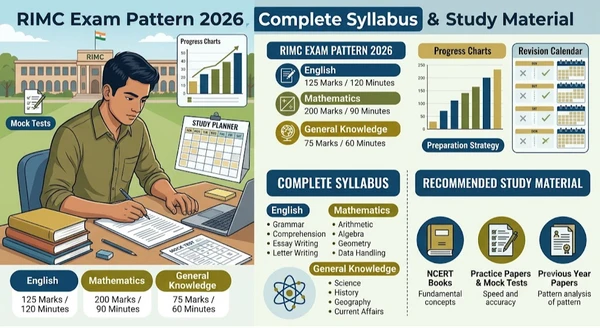
The written exam has 3 papers: English - 125 marks - Mathematics - 200 marks - and General Knowledge - 75 marks - for a total of 400 marks. Minimum 50% in each subject is required.
Candidates scoring at least 50% in each subject qualify for the 50-mark viva-voce.
So the full selection score is 450 marks - 400 from the written exam plus 50 from the viva voce. Final selection equals written plus interview marks.
Medical examinations at designated military hospitals form the final stage. Merit-based admission depends on medical fitness.
Three things to hold in mind from this structure. First, Mathematics is half the written exam - 200 out of 400. Second, the 50% minimum in every individual paper means a weak performance in English kills your chances even with perfect Maths. Third, the viva voce adds 50 real marks that separate similarly-ranked written exam candidates.
Mathematics Syllabus - 200 Marks
Mathematics and English are based on the CBSE Class 6 and 7 curriculum with deeper understanding required.
The Mathematics syllabus covers: Number System, HCF and LCM, Square and Square Root, Average, Ratio and Proportion, Percentage, Profit and Loss, Time and Distance, Time and Work, Simple Interest, Basic Operations and Factorization, Linear Equations, Set Theory, Lines and Angles, Triangles, Quadrilateral and Parallelogram, Polygon, Mensuration, Area of Field Book, and Cube and Cuboid.
The Mathematics paper additionally covers fractions, decimals, geometry, and circles.
That's a substantial list - covering arithmetic, algebra, and geometry across three years of CBSE curriculum. The depth required goes beyond what regular Class 7 school exams test. Multi-concept word problems appear frequently in Maths - meaning a question on Profit and Loss might require applying percentages, ratio, and basic algebra simultaneously rather than testing any one concept in isolation.
Speed matters too. With 200 marks and a mixed written format - not pure MCQ - a child who understands concepts but solves slowly will run out of time. Target 2 minutes per mark as a rough benchmark during practice.
Study Material for Mathematics:
R.S. Aggarwal and R.D. Sharma's books for Classes 6-8 are excellent choices for Mathematics. NCERT Class 6 and 7 Mathematics textbooks are the foundation - every chapter, every exercise. Beyond NCERT, R.S. Aggarwal's Middle School Mathematics provides the problem variety and difficulty level closest to what RIMC actually tests.
English Syllabus - 125 Marks
English is where most candidates fall short of the 50% qualifying threshold. Not because it's the hardest subject conceptually - but because it's the one most families under-prepare for.
The English paper evaluates grammar, comprehension, vocabulary, and writing skills.
More specifically, English covers comprehensive grammar including error correction and transformation, vocabulary at Class 8-9 level, and longer comprehension passages.
The writing component is what makes RIMC English genuinely demanding. Essay writing and letter writing appear in the RIMC English paper - and these are descriptive, not MCQ. A child who has only practiced multiple-choice grammar questions will be unprepared for a 200-word essay on national values or a formal letter to a Commandant.
The comprehensive topics in English include essay writing, grammar, vocabulary, and sentence structure.
Wren and Martin's High School English Grammar and Composition and Norman Lewis's Word Power Made Easy will strengthen your English foundation.
Wren and Martin is the grammar standard - work through the exercises on tenses, articles, prepositions, and error correction systematically. Norman Lewis builds vocabulary in a structured way - genuinely useful for the comprehension and vocabulary sections.
The one daily habit that builds English more than any workbook: writing. One essay or letter every day - 150 to 200 words, on a topic drawn from current events, school life, patriotism, or national issues. Get it reviewed by a teacher or parent. The turnaround and feedback are what produces improvement.
General Knowledge Syllabus - 75 Marks
General Knowledge covers History, Geography, General Science, General Knowledge and IQ Tests, and Sports.
GK covers Indian history, geography, constitution, defence, current affairs, sports, and science.
The defence-specific component of RIMC GK preparation is what distinguishes it from standard GK for any other exam. RIMC is a military institution. The examiners expect candidates to know more than just textbook Indian history - they expect awareness of India's armed forces structure, famous military operations, current service chiefs, and defence-related national events.
Build a dedicated defence GK notebook alongside the standard history and geography revision. Thirty minutes of defence-specific reading per week - military ranks, famous battles, NDA structure, RIMC alumni who became Chiefs of Staff - adds up into a meaningful GK edge by exam day.
Lucent's General Knowledge book and Manorama Yearbook serve as comprehensive resources for General Knowledge.
Lucent covers static GK - history, geography, constitution, science facts - thoroughly. Manorama Yearbook handles current affairs comprehensively. Both together cover the full GK scope without any significant gaps.
The Viva Voce - 50 Marks That Families Ignore
Candidates scoring at least 50% in each subject qualify for the 50-mark viva-voce.
The viva is not ceremonial. It adds 50 real marks to the selection score, and at the level of competition RIMC operates at - where written scores among top candidates cluster closely - 50 marks from the viva is the actual differentiator.
The panel typically consists of senior officers from RIMC. They assess personality, communication ability, confidence, and awareness. They ask about the candidate's background, school, hobbies, current events, India's defence forces, and why the child wants to join RIMC specifically.
A child who answers "I want to serve the nation" without any specific knowledge of what RIMC is, what NDA is, or how RIMC alumni have contributed to the armed forces - gives a weak viva performance. A child who can tell the panel that RIMC was established in 1922, that it feeds directly into NDA, and that it has produced multiple Chiefs of Staff - demonstrates genuine interest and preparation that the panel notices immediately.
Practical preparation: weekly mock interview sessions from month 3 of preparation onward. Ask the child questions out loud - about their family, their school, their hobbies, current national news, and specifically about the defence forces. Practice in front of a mirror. Improvement in interview performance is real and measurable with consistent practice.
Study Material - The Complete Recommended List
A well-laid-out study schedule should dedicate specific time to each subject. Previous year papers give you valuable insights about the exam pattern. Solving these papers helps improve your time management skills and highlights your strengths and weaknesses.
Here's the complete study material list for RIMC 2026:
Mathematics: NCERT Class 6 and 7 Mathematics - primary. R.S. Aggarwal Middle School Mathematics - practice and variety. R.D. Sharma Class 7 - additional depth on geometry and algebra.
English: Wren and Martin's High School English Grammar and Composition - grammar foundation. Norman Lewis's Word Power Made Easy - vocabulary. Daily newspaper reading - The Hindu or Times of India - for comprehension speed and current awareness.
General Knowledge: Lucent's General Knowledge - static GK. Manorama Yearbook - current affairs. A self-maintained defence GK notebook - updated weekly.
Previous Year Papers: The official RIMC booklet distributed with the prospectus includes old question papers. These are the closest available benchmark for the actual exam - solve them timed, under exam conditions, starting month 6 of preparation.
Coaching Guide: The Arihant Rashtriya Indian Military College Class 8 Guide provides complete preparatory material, solved papers, and practice sets aligned to the RIMC pattern. It's a reasonable single-volume reference if you want all three subjects covered in one guide book.