
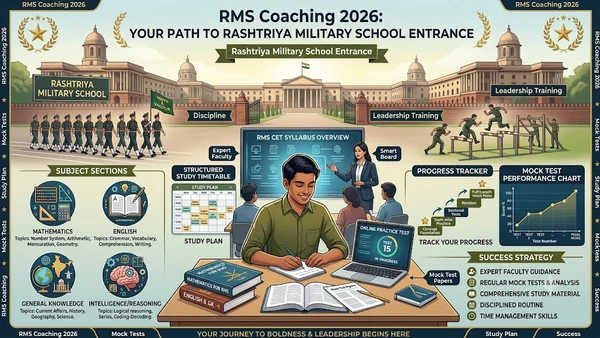
The tentative date for the Rashtriya Military School Combined Entrance Test 2026 is 6 December 2026. Students must start preparation early so that they have sufficient time to prepare, revise, and practice a lot. The standards and competition are higher than one could think.
That last line is the one most families underestimate. RMS is not a "backup" to AISSEE. It's a competitive, respected entrance leading to institutions that run under direct Ministry of Defence oversight - schools that have been producing Army Chiefs and senior military officers since 1925. The alumni of Rashtriya Military Schools occupy high positions in the Armed Forces and in other sectors, doing great service to the motherland.
Here's how to prepare for it properly.
First - Know What You're Preparing For
Understanding the exam structure before opening a single book is non-negotiable.
The RMS Class 6 entrance exam has 200 multiple choice questions in total - 50 questions each from Mathematics, English, Intelligence Test, and General Knowledge. The exam is OMR-based with a duration of 2.5 hours. There is no negative marking - students must attempt all 200 questions.
The RMS CET ↗ Class 6 medium of examination is bilingual in Hindi and English. The exam questions will be based on the Class 5 CBSE curriculum.
For Class 9, the structure changes. For Class 9, the RMS entrance exam covers English, Mathematics, Hindi, Social Science, and Intelligence. Candidates must secure a minimum of 50% marks in each subject to qualify, followed by a medical examination.
For Class 6, candidates must score a minimum of 40% in Mathematics, General Knowledge, and Intelligence, while for Class 9, the minimum score is 50% for each paper.
That difference in qualifying bar - 40% for Class 6 versus 50% for Class 9 - signals how the difficulty calibration shifts between the two levels. Class 9 is meaningfully harder, and the per-subject minimum means a weak performance in any one area eliminates a candidate regardless of strong scores elsewhere.
The selection process includes: written exam, interview of 20 marks for qualified candidates, and medical test for final selection based on fitness.
Three stages. All three must be passed. Most preparation goes into the written exam. The interview and medical are often treated as afterthoughts - which is a mistake, because the interview adds 20 marks to the written score and directly shapes the final merit list.
Subject-Wise Preparation Strategy
Mathematics - Start Here, Stay Here
Mathematics is one of the highest-scoring subjects in the RMS Class 6 exam if a student has practised regularly. The RMS Maths Syllabus for Class 6 is based on CBSE Class 5 Mathematics with some topics extending to early Class 6 level. Speed and accuracy are both critical - 50 questions in 37-38 minutes if equal time is allocated demands quick mental calculation.
NCERT Class 5 Mathematics is the foundation. Every chapter must be completed with all exercises - not skimmed. Beyond NCERT, a dedicated Mathematics workbook adds problem variety and builds the speed needed to get through 50 questions within the time allocated.
Allocate specific time slots for each subject during preparation and adhere to them strictly. For most children, Mathematics needs the largest daily time allocation - roughly 45 minutes to an hour - because it requires both concept understanding and calculation speed that only repetitive practice builds.
For Class 9, topics expand to include Algebra, Mensuration, Linear Equations, Geometry, and basic Statistics. NCERT Class 8 Mathematics is the primary source. HOTS - Higher Order Thinking Skills - questions appear in Class 9 RMS more frequently than at Class 6 level. Practice multi-step word problems regularly, not just formula-application exercises.
English - The Section That Trips Up Most Students
GS Defence Academy created a step-by-step method to strengthen the English section. Their curriculum puts special focus on creative writing skills - students learn essay writing, story composition, and other forms of expression needed for entrance examination.
For Class 6, English covers reading comprehension, grammar - tenses, prepositions, articles, sentence correction - vocabulary, and basic writing. Grammar from NCERT Class 4 and 5 English textbooks is the starting point. Supplement with Wren and Martin's basic grammar exercises.
Students need to read both printed newspapers alongside online resources and magazines to stay updated, particularly for building vocabulary and comprehension reading speed.
One English exercise daily - a comprehension passage on one day, a grammar exercise the next, vocabulary study the day after. Rotate through these consistently rather than doing the same type of practice every day.
For Class 9, English demands are higher. Comprehension passages are longer, grammar complexity increases, and essay-type questions require structured writing. Practice 150 to 200 word essays on current affairs, national values, school life, and sports - topics that commonly appear in RMS English sections at Class 9 level.
Intelligence and Reasoning - The Practice-Only Section
Intelligence questions cover series completion, analogies, coding-decoding, pattern recognition, mirror images, and logical sequences. This section doesn't respond to theory reading - it improves only with repetitive practice.
The Intelligence Test section can be tricky for unprepared students. Regular practice of previous year papers significantly improves performance and confidence.
20 Intelligence questions daily, timed at 15 minutes, reviewed carefully. This is the correct approach - not a full chapter reading of an Intelligence textbook. Pattern recognition builds through exposure to many question types, not through conceptual study.
General Knowledge and Current Affairs
All academic focus should concentrate on the high-weightage subjects within the examination. Students need to read both printed newspapers alongside online resources and magazines to stay updated for the General Knowledge section.
Static GK - Indian history, geography, constitution, national symbols, important dates, science facts - comes from a GK reference book. Lucent's General Knowledge is the standard. Cover it chapter by chapter over the preparation period.
Current affairs need daily reading. 15 minutes daily of newspaper reading - The Hindu or Times of India - focused on national news, science discoveries, defence developments, and sports. Build a monthly current affairs notebook - one page of key events per week.
For RMS specifically, defence-related GK carries additional relevance. Military ranks, famous operations, important battles in Indian history, current service chiefs - this category appears consistently in RMS GK sections and is worth dedicated specific preparation.
The Daily Study Schedule That Works
A recommended daily schedule: Morning - revise important formulas and concepts in Maths. Afternoon - work on English comprehension, grammar, and vocabulary. Evening - practice GK and Intelligence Test questions.
Total daily study time: 2.5 to 3 hours for younger Class 6 aspirants, 3 to 3.5 hours for Class 9 candidates. Consistency across 5 months is more valuable than intense bursts that burn out before exam day.
Regularly take OMR sheet-based mock tests to identify strengths and areas for improvement. One full-length mock per week from month 3 of preparation onward. Review every wrong answer the same day - not to feel bad about the score but to identify which topic produced the error and address it specifically.
Preparing for the RMS Interview
The interview carries 20 marks and is added to the written test score to prepare the final merit list. This is not ceremonial - it's a scored component that meaningfully separates candidates with similar written scores.
The RMS interview assesses communication, confidence, and awareness. Practice speaking clearly in English on topics including school life, hobbies, current events, why the child wants to join RMS, and knowledge of India's defence forces.
Ask the child to practice in front of a mirror and with a parent or teacher asking questions. A child who can answer "why do you want to join a military school" with a specific, thoughtful response - not a rehearsed script - creates a genuinely different impression from one who gives mechanical answers.
Physical Fitness - Don't Ignore the Medical Stage
The medical test for Rashtriya Military Schools is conducted after the interview, usually at a Military Hospital or Command Hospital. It follows strict standards as per the parameters laid down by the Indian Armed Forces.
Physical fitness preparation should run parallel to academic preparation throughout the 5-month window. 30 minutes of daily outdoor physical activity - running, outdoor games, sports - keeps fitness levels where they need to be for the medical examination.
Children who spend 5 months sitting exclusively at a desk and then face a military medical standard are at unnecessary risk of failing a medical they could have passed with simple regular activity throughout preparation.
The December 2026 Timeline
The NIELIT will release the official notification for RMS CET 2026 for the academic session 2027-28 in September 2026. Online registrations will commence on the release of the official notification.
The registration window typically lasts 4 to 6 weeks before closing in October. The exam is on 6 December 2026. Results follow in February 2027.
That means preparation starting now - July 2026 - gives a solid 5-month window before exam day. Subject foundations in July and August, mock test introduction in September, intensive mock cycle and interview preparation in October and November, light revision and mental preparation in final December days.
To succeed in military school entrance exams, start early, understand the syllabus and exam pattern, create a structured study plan, practice regularly with mock tests and previous papers, and focus on both academic and physical fitness.
That six-part prescription isn't complicated. What makes it work is doing all six consistently - not just the parts that feel comfortable.