
Rahul was in Class 8 when his father first mentioned Sainik School. "Class 9 mein try karenge," he said, casually - like it was a school project, not a national entrance exam.
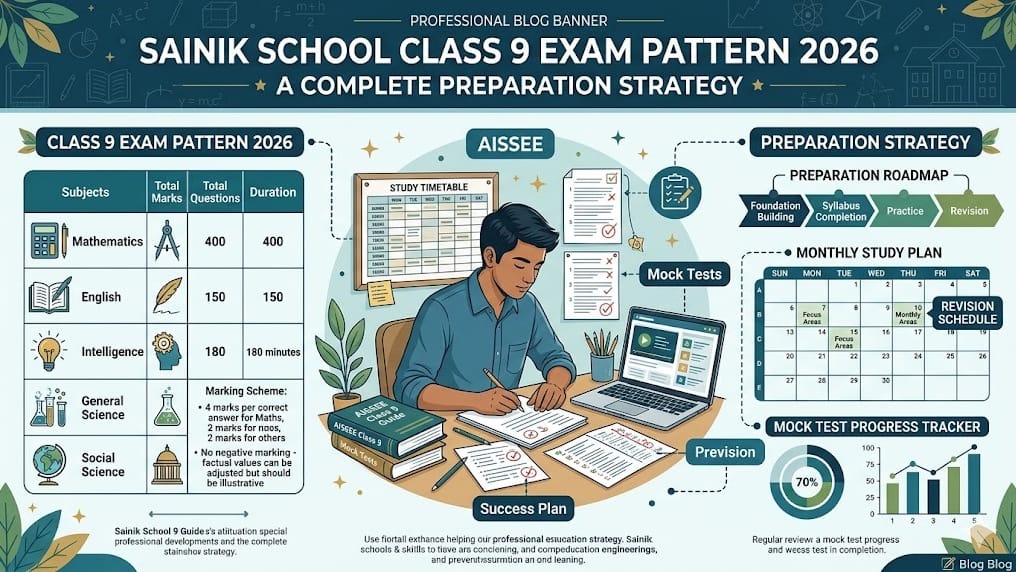
By October, reality hit. Five subjects. 150 questions. 400 marks. English only paper.
If your child is targeting Class 9 admission, the sooner you understand this exam - the better.
AISSEE 2026 Class 9: The Pattern First
|
Subject |
Questions |
Marks Each |
Total |
|
Mathematics |
50 |
4 |
200 |
|
English |
25 |
2 |
50 |
|
General Science |
25 |
2 |
50 |
|
Social Studies |
25 |
2 |
50 |
|
Intelligence |
25 |
2 |
50 |
|
Total |
150 |
- |
400 |
Three things to notice immediately.
One - Maths is 200 of 400 marks. Half. Exactly like Class 6, but harder topics and 4 marks per question.
Two - the paper is English medium only. No Hindi. No regional language. This catches students off guard, especially those from Hindi-medium schools.
Three - Intelligence is 50 marks and most students ignore it completely. That's 50 free marks left on the table.
Subject-Wise: What's Actually in the Syllabus
Mathematics - 200 Marks
The AISSEE ↗ Class 9 Maths syllabus follows NCERT Class 8 - not Class 9, not anything advanced. Topics: algebraic expressions, linear equations, mensuration, data handling, percentages, profit-loss, geometry, exponents.
4 marks per question means one silly mistake = 4 marks lost. Rahul's father told me his son lost 28 marks in one mock test just from calculation errors. "Concept sab pata tha. Haste mein galat kar diya."
Speed and accuracy together. Not one without the other.
English - 50 Marks
Tenses, prepositions, active-passive, synonyms, antonyms, comprehension - that's the core. The AISSEE preparation for English isn't complicated. It's just consistent.
Read one English article daily. Solve 5 grammar questions. That's your English prep done for the day. Fifteen minutes.
General Science - 50 Marks
Class 8 NCERT Science chapters - force and pressure, light, sound, microorganisms, metals and non-metals, chemical effects of current, cell structure. Understand how things work. Don't memorise definitions blindly.
The exam tests whether a student gets the concept, not whether they copied it into a notebook 10 times.
Social Studies - 50 Marks
History, Geography, Civics - all from Class 8 NCERT. The national movement, Indian Constitution, agriculture and industries, natural resources. Map questions on Indian geography appear regularly.
This section gets ignored. Don't let it. 50 marks is 50 marks - and it's far more predictable than Maths.
Intelligence / Reasoning - 50 Marks
Series completion, coding-decoding, analogy, direction sense, classification, mirror images. Daily practice of 10 questions is enough. Within 6 weeks, most students see a clear improvement in speed.
A 3-Month Plan That's Actually Doable
Month 1 - Go slow, go deep. Cover the full AISSEE syllabus chapter by chapter. Only NCERT Class 8 books. No shortcuts. Spend 60% of time on Maths. Rest split across other subjects.
Month 2 - Test yourself weekly. Chapter-wise tests every Sunday. After each test - not before - find weak topics and revisit them. This is where most improvement happens.
Month 3 - Full mocks only. Switch to complete mock test series on OMR sheets. 150 questions, 3 hours, full simulation. Review every error seriously. Stop studying new content - only revise what you know.
Mistakes That Cost Ranks
Leaving Intelligence for last. Students who skip reasoning lose 50 marks they could've easily scored. Fix this in Month 1 itself - just 10 questions a day.
Ignoring the English-only format. If your child studies everything in Hindi at school, start reading English actively from Day 1. Don't discover this problem in Month 3.
Practising without a timer. 150 questions in 180 minutes = 72 seconds per question. Untimed practice builds false confidence. Always use a stopwatch.
The Honest Truth About This Exam
The Sainik School Class 9 entrance exam doesn't care how smart your child is in a vacuum. It cares how well they perform under time pressure, across five subjects, in English, on an OMR sheet.
That's a specific skill set. And it's built through practice - not pressure.
Start structured. Stay consistent. January will come whether you're ready or not.