
The result is out. Your child's scorecard is downloaded. And now comes the question that's been sitting in the back of your head since January - is it enough?
Here's the thing parents often don't realise. There isn't one answer to that question. The same score can be more than enough at one school and fall short at another. It can qualify comfortably in one category and barely make it in another. Everything depends on where your child applied, which domicile they carry, and which category they're registered under.
Let's work through this properly.
Two Numbers That Mean Very Different Things
Before getting into the actual figures, you need to understand something that most families confuse.
There are two very different numbers in this process:
The minimum qualifying mark - the floor below which a candidate cannot proceed at all, regardless of seats or competition.
The admission cut off - the actual competitive score where seats fill up at a specific school for a specific category and domicile combination. This is always significantly higher than the minimum.
The minimum qualifying marks for AISSEE ↗ 2026 are 45% for General category students and 40% for OBC-NCL, SC, ST, and Defence category. For Class 6 with 300 total marks, that's 135 marks for General and 120 for reserved categories. Simple enough.
But meeting those minimums doesn't put your child anywhere close to a seat. Cutoff marks decide the final admission to Sainik Schools - not the minimum qualifying marks. The real competitive bar is far higher. That's what we're going to break down here.
Expected Cut Off Marks for Class 6 in 2026
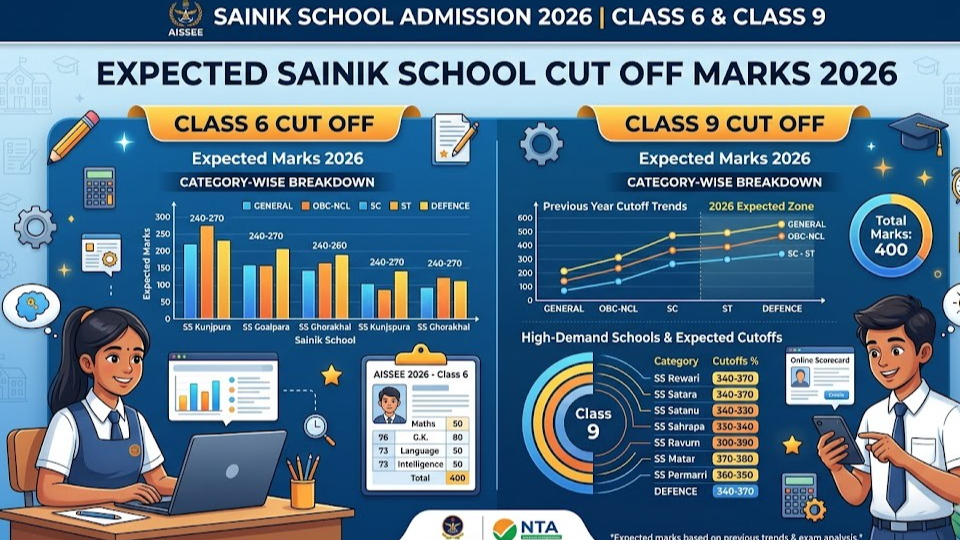
Class 6 AISSEE is written for 300 total marks. Based on previous year trends, the expected Sainik School cut off marks for Class 6 in 2026 for General category range between 210 and 250 marks.
For Class 6, the approximate competitive cut off is 220 to 240 marks and above. Let's go category by category.
General Category - Boys: 210 to 250 marks The range is wide because it varies school to school. High-demand schools in competitive states like Maharashtra, Rajasthan, and Haryana push toward the upper end. Schools in the Northeast or Punjab tend to sit lower.
General Category - Girls: 220 to 270 marks Girls' cut offs at competitive schools sit around 270 and above, while boys typically see 260 and above in the more competitive OBC and General pools. The girl quota at each school is separate and competition within it is distinct.
OBC-NCL Category: 185 to 230 marks Still meaningfully lower than General. But the gap has been narrowing every year as more OBC families access coaching and preparation resources.
SC Category: 160 to 200 marks For SC and ST candidates, admission is based on relative merit subject to medical examination and document verification - there is no fixed aggregate minimum. In practice, strong SC candidates usually score well above the lower end of this range.
ST Category: 140 to 180 marks Fewer candidates in the ST pool at most schools means slightly lower competitive pressure within the category. But absolute seat numbers are also limited.
Defence Category: 185 to 230 marks DEF candidates compete within a separate 25% seat pool. Competition inside this category is generally less intense than General, which often translates to lower admission cut offs even though the minimum qualifying bar is the same.
Expected Cut Off Marks for Class 9 in 2026
Class 9 is written for 400 total marks and the situation is tighter across the board.
The expected Sainik School cut off marks for Class 9 in 2026 for General category range between 280 and 320 marks.
The expected cut off for Class 9 General category ranges between 300 and 350 at the more competitive schools. The wide range reflects how dramatically cut offs vary between high-demand and lower-demand schools.
General Category: 280 to 320 marks at most schools. Top-ranked schools in competitive states can go higher.
OBC-NCL Category: 250 to 285 marks SC Category: 210 to 245 marks ST Category: 185 to 220 marks Defence Category: 245 to 275 marks
A total of 1,78,022 students appeared for AISSEE 2026. Due to limited seats across Sainik Schools, competition remains high every year. For Class 9, total available seats are approximately 600 to 800 nationally - compared to 1,800 to 2,000 for Class 6. Fewer seats, same number of serious candidates. That's what makes Class 9 cut offs consistently higher and less forgiving.
Why the Same Score Gives Different Outcomes at Different Schools
This is the part of the cut off discussion that most guides skip over - and it's genuinely the most important part.
Every Sainik School reserves 67% of its seats for home state students and 33% for all-India quota. Home state applicants face lower competition, while all-India quota students face a higher bar. Always confirm which quota you fall under before comparing scores.
So two candidates from different states, both scoring 225 in Class 6 General, face completely different competitive environments. One is home-state at a school with relatively few local applicants. The other is applying outside their state to a highly competitive school. Same marks. One might get a seat. The other might not even come close to the cut off.
Sainik School Kapurthala in Punjab consistently maintains some of the most accessible cut offs among all Old Sainik Schools - General category candidates from the home state fall between 200 and 250 marks at the admission stage.
Sainik School Chittorgarh in Rajasthan shows home state cut offs for boys at around 275 to 277, and for girls at 284 to 286. Sainik School Satara in Maharashtra sees home state cut offs for girls as high as 288.
Schools in Northeast states typically have more accessible cut offs due to fewer applicants from those home states. New Sainik Schools require only 40% aggregate for all categories and generally have lower competitive cut offs than Old Sainik Schools.
Why Cut Offs Keep Rising Every Year
It's not your imagination. Scores needed to get into Sainik Schools are genuinely higher today than they were five years ago.
Cut offs have risen consistently every year as applicant numbers grow while seats remain limited. The total seat count hasn't changed much. The number of families who know about Sainik Schools - and the quality of preparation those families are accessing - has grown dramatically.
States with strong coaching ecosystems - Punjab, Haryana, Himachal Pradesh, Delhi, Rajasthan - consistently show higher cut offs because average preparation quality in those states pushes up the competitive floor.
Because of high competition in 2026, expected cut offs may slightly increase compared to previous cycles. If your child scored close to the 2025 cut off range, don't assume 2026 will be the same. It may be a few marks higher.
Where to Check the Official Cut Off Once Released
The official school-wise cut offs for AISSAC 2026 are available on the official portal - visit it regularly for the latest schedule as cut offs are released round by round.
The portal address is pesa.ncog.gov.in/sainikschoolecounselling. Log in with your AISSAC credentials and look for school-wise cut off data after each allotment round. The cut offs are released per round - not all at once - and they sometimes dip slightly in later rounds if seats remain vacant.
To check school-wise cut offs, students need to visit the Sainik School e-counselling portal, sign in using their application number, password, and captcha, then access the school-specific cut off section.
When comparing your child's score, use the right reference. Home-state cut off if your child's domicile matches the school's state. Outside-state cut off if it doesn't. Category-specific cut off - not General - if your child is registered as OBC, SC, ST, or DEF.
A score that's five marks below the expected General cut off might still be comfortably above the OBC cut off. A score that falls short at a high-demand school could easily clear the bar at a school with fewer home-state applicants. The number on the scorecard is only half the story. Where that number sits in the specific pool your child is competing in - that's what actually determines the outcome.