
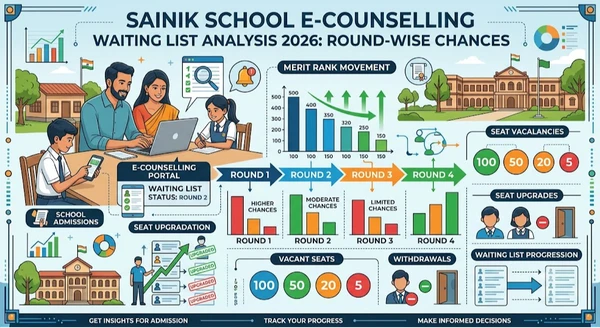
The counselling portal showed no allotment in Round 1. The family checked again. Still nothing. Now Round 2 is approaching and the question everyone on the waiting list is asking is the same: what are my actual chances?
The honest answer isn't a single number. It depends on how close to the Round 1 cut off your child's score sits, which schools are on your preference list, which category and domicile pool you're in, and what happens to candidates above you in each subsequent round.
Here's the round-by-round analysis based on how AISSAC consistently runs.
How the AISSAC Round System Works
The Sainik School waiting list can be checked on the official portal, pesa.ncog.gov.in, by clicking on the "counselling process" tab on the homepage. It will be released in April and May after AISSEE ↗ 2026 results.
The final merit list for AISSEE 2026 is expected to be published in May 2026 after the completion of medical exams.
AISSAC runs multiple sequential rounds. After each round, every allotted candidate must respond - Accept, Reconsider, or Exit - within a short window. Their response determines seat availability for the next round. Fresh registration is available in the 2nd Round for candidates who have not registered in the 1st Round of counselling. Freshly registered candidates need to fill choices.
Understanding what happens in each round tells you when your chances are highest - and when they start to narrow.
Round 1 - The Highest Cut Off, Lowest Waiting List Benefit
Round 1 carries the highest cut offs in the entire cycle. The most competitive candidates - the ones with the strongest ranks - are concentrated in Round 1 allotments. Every school fills its most competitive seats first.
For waiting list candidates, Round 1 itself offers no direct movement - you're either allotted or you're not. But Round 1 sets the baseline from which movement builds.
The key number from Round 1: how many marks below the Round 1 cut off is your child? This gap - 5 marks, 15 marks, 30 marks - tells you how much movement needs to happen in subsequent rounds for your child's rank to become allot-worthy.
Round 1 cut offs in AISSEE 2026 were released in April 2026 on the official portal. The AISSEE 2026 cut off marks released on the official portal show the minimum scores at which seats were filled in each category at each school, released round by round after each allotment.
Round 2 - The Highest Movement Round
Round 2 is where the waiting list moves most significantly. This is because Round 1 allotments include many candidates who received a school that wasn't their first preference. They accepted provisionally while hoping for better options. In Round 2, a significant portion choose Reconsider - releasing their Round 1 seat and re-entering the pool for remaining available seats.
Once you are allocated a seat and you have opted for reconsideration, your accepted seat from the earlier round will be automatically cancelled and you cannot get the previously allotted seat.
Historical pattern: the reconsider rate in Round 1 is typically between 15 and 25% of all allotted candidates. At a school with 90 total seats, that's potentially 10 to 20 seats returning to the pool for Round 2. This is the largest single source of waiting list movement in the entire cycle.
Additionally, Round 2 introduces fresh registrations - candidates who have not registered in the 1st Round of counselling can register afresh for the 2nd Round. While fresh registrants add competition, the net effect of Round 1 reconsidering typically still produces meaningful movement downward through the waiting list.
For a candidate 5 to 10 marks below the Round 1 cut off across multiple preferred schools - Round 2 is where most eventual allotments happen. The movement is genuine and consistent.
Round 3 - Medical Failures and Non-Reporters Drive Movement
Round 3 movement comes from a different source than Round 2. By Round 3, most candidates who wanted to reconsider have already done so. The fresh movement now comes primarily from:
Candidates who accepted seats in Round 1 or 2, attended the medical examination, and were declared medically unfit. Their seat is released back into the pool.
Candidates who accepted seats but failed to report to the school by the prescribed deadline. If you do not report to the allocated school before the last date as per timeline, it will be considered that you are not interested in joining the school and the allotted seat will be cancelled. Non-reporters create vacancy that flows into Round 3 allotments.
The volume of movement in Round 3 is smaller than Round 2 but still meaningful - medical failures and non-reporters typically account for 5 to 10% of allotted seats returning to the pool. At a school with 90 seats, that's 4 to 9 additional opportunities entering Round 3 that didn't exist after Round 1.
For candidates 10 to 20 marks below the Round 1 cut off, Round 3 is the realistic window for allotment. Not certain - but genuinely possible if the schools in their preference list see reasonable medical failure and non-reporter rates.
Round 4 and Beyond - Residual Seats, Tighter Chances
By Round 4, the pool of returning seats is significantly smaller. Most reconsidering has happened. Most medical failures have been processed. The seats remaining are genuinely residual - specific vacancies that arose from late medical reports, schools that saw higher-than-expected medical failure rates, or category-specific vacancies that built up through rounds 1 to 3.
If some reserved seats are left unfilled - for example, no candidate in ST or no girl applicant in some category - they may be reallocated to other categories or among quotas following rules.
This redistribution is where candidates in one category occasionally benefit from vacancy in another. A school with unfilled SC seats may redistribute those to the home-state General pool in Round 4 if no eligible SC candidates remain on the waiting list. A school with unfilled outside-state seats may offer them to home-state candidates.
For candidates more than 20 marks below Round 1 cut offs across all preferred schools - Round 4 and beyond represents genuinely thin chances. Not zero, but statistically unlikely without specific circumstances like a school seeing unusually high medical rejection rates.
The Single-School Choice Waiting List - A Special Case
Sainik School waiting list - single school choice waiting list, limitations and conditions - is on the official portal.
Some candidates registered with only 1 or 2 school preferences - which this guide has consistently warned against. For these candidates, the waiting list dynamics are more limited because they're only benefiting from movement at those specific schools rather than across a broader portfolio of choices.
If your child's preference list has fewer than 5 schools, and you're not within 15 marks of any of their cut offs - the realistic path forward is either reconsidering whether to add schools to the list in Round 2 (if fresh registration options exist) or acknowledging that the 2026 cycle is likely closed and pivoting to 2027 preparation.
Round-by-Round Summary: Realistic Waiting List Chances
|
Gap Below Round 1 Cut Off |
Round 2 |
Round 3 |
Round 4+ |
|
1-8 marks |
High |
Moderate |
Low |
|
8-15 marks |
Moderate |
Moderate |
Low |
|
15-25 marks |
Low |
Low |
Very Low |
|
25+ marks |
Very Low |
Very Low |
Unlikely |
These ranges apply within a well-constructed 10-school preference list. Candidates with fewer choices, or choices concentrated only in high-competition schools, face narrower chances at every round regardless of how close they are to the cut off.
What Waiting List Candidates Must Do in Every Round
If you were allocated and confirmed the seat in a certain round and now you are not interested in joining the allocated school, you must submit your unwillingness to the school through mail. Besides, if you do not report to the allocated school before the last date, it will be considered that you are not interested in joining the school and the allotted seat will be cancelled.
Log into the AISSAC portal every day during active rounds. When an allotment appears, respond immediately - don't wait to see if something better comes. The response window is short. A missed window is permanent.
Keep all documents ready before any allotment appears. Domicile certificate, birth certificate, category certificate, Aadhaar, medical forms - all of them. The time between allotment and medical to school reporting is compressed in later rounds. Families that scramble for documents lose days they don't have.
And critically - if an allotment appears in Round 3 or 4 at your 7th or 8th preference school, think very carefully before reconsidering. Once you are allocated a seat and opted for reconsideration, your accepted seat from the earlier round will be automatically cancelled and you cannot get the previously allotted seat. A confirmed seat at a decent school in Round 3 is worth more than the chance of a better school in Round 5 that may or may not materialise.