
Here's something most parents discover too late - well after they've filled their choice list and locked it.
Not all Sainik Schools are equally competitive. Two schools can follow the same admission process, offer the same quality of residential education, and both carry the Sainik School name - yet one needs 240 marks and another is accessible at 200. The difference is real. And understanding it before you fill the AISSAC portal is the difference between getting a seat and going home empty-handed.
Let's go through which schools tend to have lower cut offs, why they stay lower, and how to use that information properly.
Why Cut Offs Differ So Much Between Schools
Before the school list, the logic matters. Because if you understand why some schools have lower cut offs, you can apply that reasoning even to schools not mentioned here.
Every Sainik School reserves 67% of its seats for home state students and 33% for all-India quota. Lower cut off schools - particularly Sainik School Kapurthala in Punjab and schools in Northeast states - typically have more accessible cut offs due to fewer applicants from home states.
That's the core reason. Fewer home-state applicants competing for the same number of seats means the admission bar is naturally lower. It has nothing to do with school quality - it's pure supply and demand within a geographically defined quota pool.
Two other factors push cut offs down at certain schools. First, states with lower population density and smaller coaching ecosystems produce fewer competitive candidates. Second, schools that are newer to the AISSEE ↗ process haven't yet built up the large applicant bases that drive up scores year on year.
Cut offs have risen consistently every year as applicant numbers grow while seats remain limited. The schools that have stayed at the lower end are the ones where applicant growth has been slower - usually for geographic or awareness-related reasons, not quality reasons.
Sainik School Kapurthala - The Consistently Accessible Option
This school comes up in virtually every cut off conversation. Parents from Punjab know it well. Parents from other states often overlook it because it's not as prominent in national rankings.
Sainik School Kapurthala in Punjab has the lowest cut off marks among Old Sainik Schools based on previous year data.
General category candidates from the home state at Sainik School Kapurthala fall between 200 and 250 marks at the admission stage for Class 6. That's meaningfully lower than what high-demand schools in Maharashtra or Rajasthan require.
For families from Punjab - this school gives a strong home-state advantage on top of the already-accessible cut off. For families from other states applying in the 33% outside quota, the competition is still real. But the competitive bar there is lower than at high-demand national schools simply because fewer outside-state candidates target Kapurthala specifically.
Northeast Sainik Schools - Genuinely Accessible, Often Ignored
Schools in the Northeast region of India consistently sit at the lower end of the cut off range. Not because they're less good - but because fewer families from those home states are competing at the same intensity as families in, say, Haryana or Rajasthan.
Schools in Northeast states typically have more accessible cut offs due to fewer applicants from home states.
For a family from the Northeast, these schools offer the combined advantage of home-state quota priority and lower overall competition. A candidate who might fall short at a school in a more competitive state can often find their score well within reach at a school in Nagaland, Manipur, or Sikkim.
For outside-state applicants, the 33% quota still applies. But the overall competitive pressure on that 33% is lower too, simply because the total pool of competing candidates is smaller.
New Sainik Schools - The Most Accessible Entry Point
If your child's score is in the 180 to 220 range and you're worried about making any cut off at all, New Sainik Schools deserve serious attention.
New Sainik Schools require only 40% aggregate for all categories - and generally have lower competitive cut offs than Old Sainik Schools.
The minimum aggregate requirement across all categories at New Sainik Schools is the same - 40%. That's lower than the 45% required for General category at Old Sainik Schools. And because awareness about NSS is still lower than awareness about the original 33 schools, competition within the NSS pool tends to be softer.
AISSEE 2026 covers admission to 33 Old Sainik Schools and 38 approved New Sainik Schools under the Sainik Schools Society. That's 38 additional opportunities most parents don't fully consider. Each one follows the same merit-based, AISSEE-linked admission process. Many are well-run schools in partnership with established educational institutions.
If your child's score is borderline and you haven't included several New Sainik Schools in your preference list - add them now.
Schools in States With Fewer AISSEE Applicants
Some states simply produce fewer AISSEE applicants than others. States like Himachal Pradesh, Uttarakhand, Chhattisgarh, Jharkhand, and Odisha tend to have lower applicant volumes than states like Uttar Pradesh, Rajasthan, or Maharashtra.
Sainik schools located in these lower-volume states often see home-state cut offs that are noticeably softer. For Class 6, the expected cut off marks range between 210 to 250 marks for General category - but this range varies dramatically based on state and school specific applicant numbers. A school in Chhattisgarh or Jharkhand may see its General category home-state cut off sit closer to 200 to 215, while a school in Maharashtra might be at 270 for the same category.
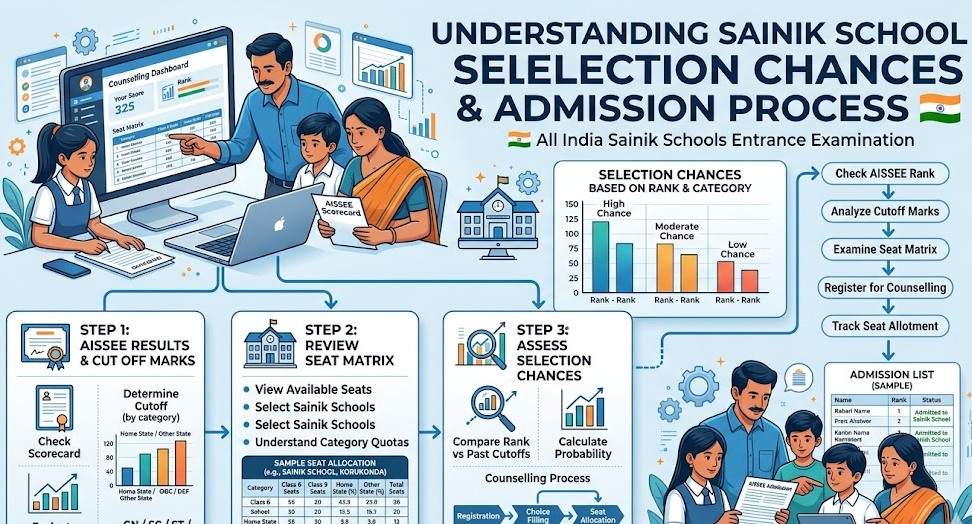
The official school-wise seat matrix on the AISSAC portal carries vacancy numbers for each category. Schools with more vacancies in your category generally indicate lower competition - and therefore lower effective cut offs - even before the official round-wise cut offs are published.
How to Use Low Cut Off Schools in Your Choice List
Finding the lower cut off schools is only half the job. Using them correctly in your 10-choice list is the other half.
Don't put lower cut off schools at slot 1 if there are schools you genuinely prefer more. The system allocates from your first preference downward. A school with a lower cut off belongs in the middle and lower slots of your list - as realistic options that protect against not getting through at the more competitive schools above them.
Candidates are advised to make a tentative list according to their preference of schools after going through the seat matrix uploaded on the website before choice filling and locking. Read that instruction carefully - it's the official guidance. The seat matrix is published before choice filling opens. Use it.
The seat matrix tells you how many seats exist in your specific category at each school. A school with 15 General category boys' seats is far more accessible than one with 4. That number - seats in your category - is more useful than school reputation alone when deciding where to aim.
Scoring 240 marks and above for Class 6 General category significantly improves chances of securing a top school. If your child scored below that - say, 205 to 225 - a strategy that mixes one or two aspirational choices at the top with realistic lower cut off schools from slot 4 onward gives the best overall outcome.
The One Mistake to Avoid
Ignoring a school just because it's not famous.
Sainik School is Sainik School. The training, the discipline, the residential experience, the NDA pathway preparation - those exist at every school carrying the name. A child who gets into Sainik School Kapurthala at 210 marks gets the same foundational experience as a child who gets into Sainik School Ghorakhal at 255.
Cutoff marks decide the final admission - not the minimum qualifying marks. Your child meeting the qualifying floor and missing the competitive cut off at top-choice schools doesn't mean they miss Sainik School. It means you need to look at which school their score can actually get them into.
That school exists. The AISSAC portal lists all of them. The seat matrix tells you where seats are. And a choice list that includes realistic lower cut off options makes sure you actually use the rank your child earned.