Most families treat the Sainik School medical examination as a formality. They assume their child is healthy enough, pack the documents, and show up on the day.
Then the doctor flags something. And it's the first time the family is hearing about that particular standard.
That shouldn't happen to your child. This blog covers every single fitness criterion doctors check - what passes, what fails, and what the borderline looks like - so you can prepare properly before the examination day.
The Standard Being Applied
Before going into individual criteria, understand the baseline standard being used.
The standard of health and medical fitness for Sainik School admission ↗ is the same as laid down for the NDA Examination. Keeping in mind the tender age of the boys and girls, however, no absolute standards of height, weight, and chest measurement are applicable at the time of admission.
This is important to read carefully. The fitness standard is modelled on NDA requirements - which are serious, military-grade standards. But the application is adjusted for the age group. Doctors are checking whether your child is physically capable of the life Sainik School demands - daily physical training, residential living, structured discipline - not whether they're ready for combat today.
Candidates who have successfully cleared the written examination are shortlisted for a medical examination conducted at authorised military hospitals or government hospitals near the school.
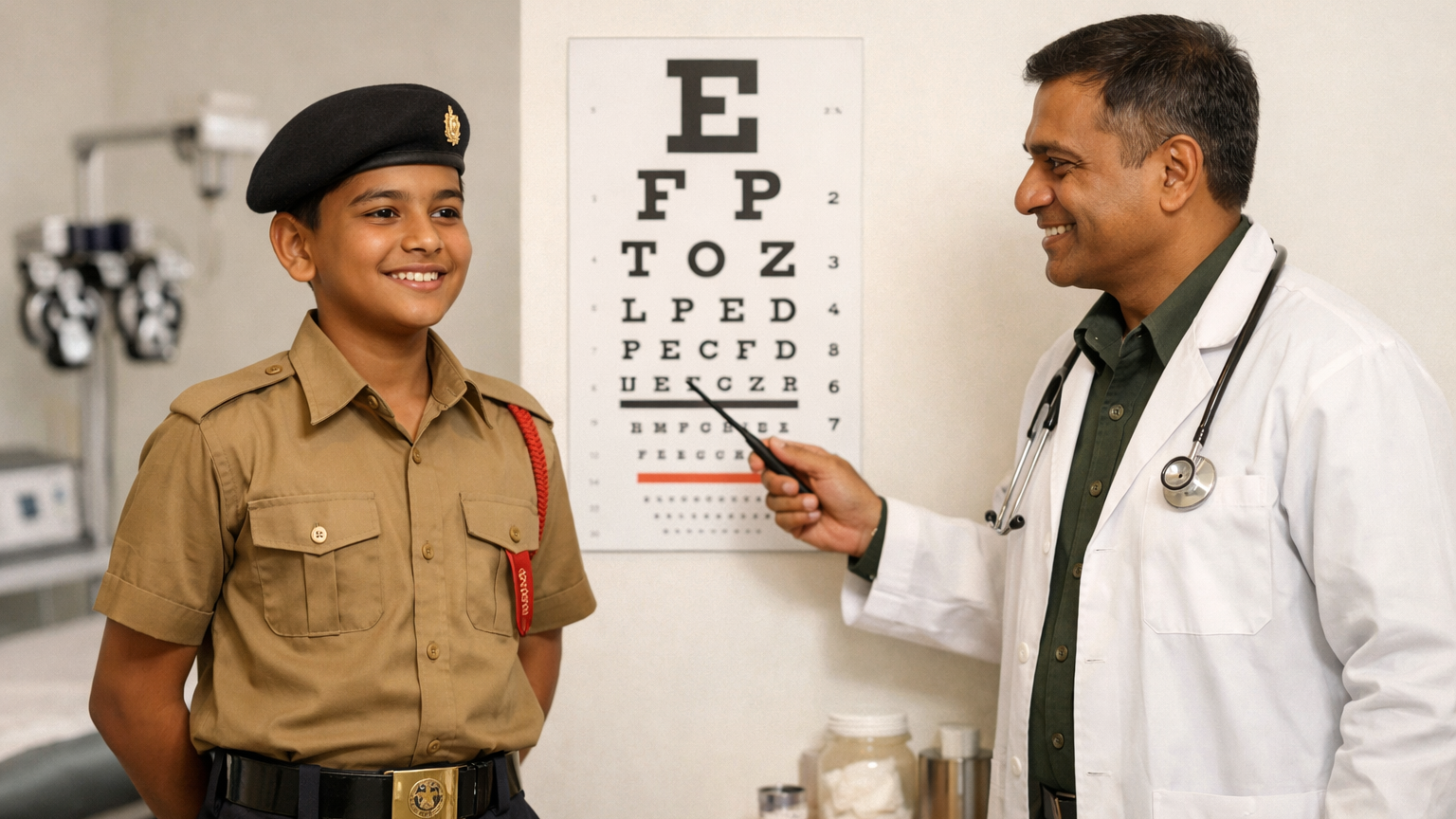
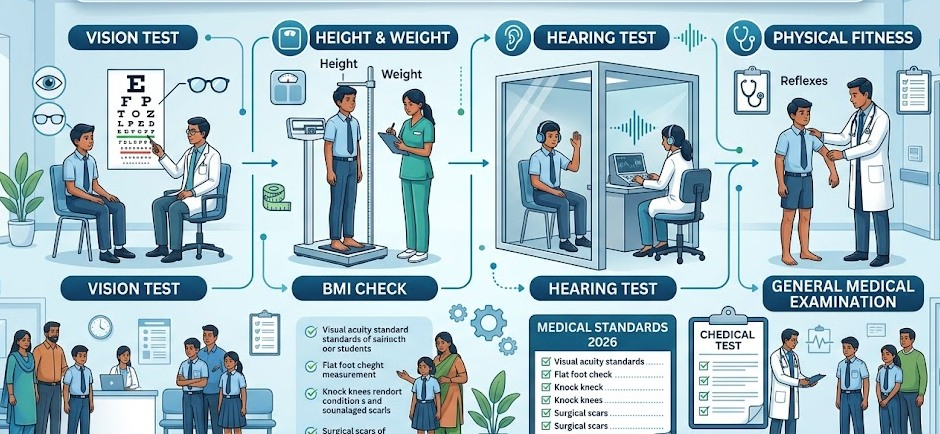
1. Vision - The Most Critical Standard
More candidates fail on vision than any other criterion. Know this one inside out before the examination.
The minimum acceptable visual standards are: Standard I - Distant Vision uncorrected 6/6 in both eyes. Standard II - Distant Vision, better eye 6/18, worse eye 5/18, correctable to 6/16 and 6/19. The minimum acceptable visual standard for admission to Sainik School is Standard II.
Myopia must not exceed minus 1.5 including astigmatism.
That last line is the one most parents miss. Minus 1.5 is the myopia limit. Not minus 2.5. Not minus 2.0. Minus 1.5 - including astigmatism. If your child wears glasses with a prescription beyond this, they will be rejected at vision screening.
Each eye must have a complete field of vision, and both binocular vision and depth perception - stereopsis - must be normal.
Candidates with squint, colour blindness, or night blindness are declared unfit.
Get a proper ophthalmologist assessment - not a school optometrist, not a spectacle shop reading - before the medical date. Know your child's exact eye power, including astigmatism values, before you walk in.
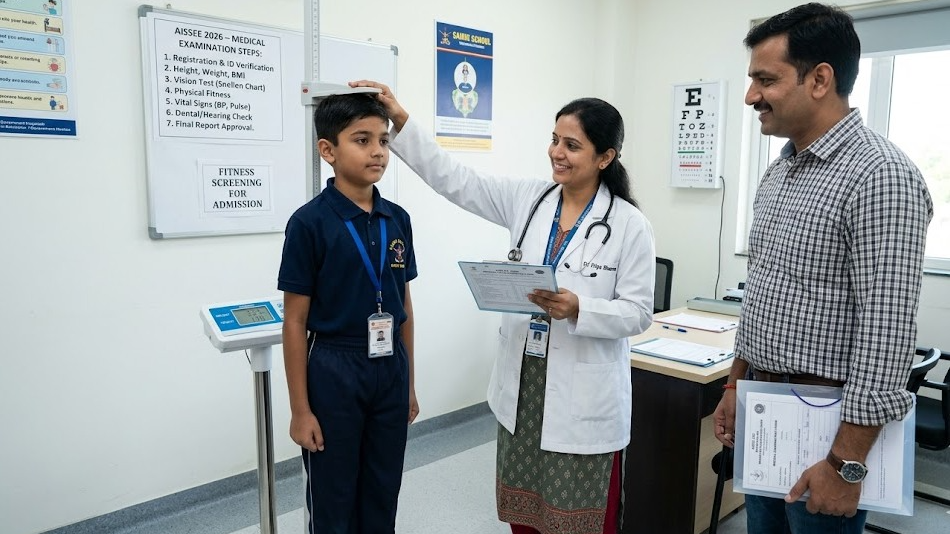
2. Height and Weight
No absolute standards of height and weight are applicable at the time of admission - but body weight must remain within the maximum limit as per the standard height-weight chart for the applicable age group.
The candidate must show no signs of poor physical build, underdevelopment, major deformities, or obesity. Body weight should remain within the maximum limit specified in the standard height-weight chart for ages 10-11 years for Class 6 and 13-14 years for Class 9.
In practice - significantly underweight or overweight children are flagged. The doctor isn't using a single pass-fail number for height. They're looking at whether the child's physical development appears normal for their age and whether their weight is proportionate.
Doctors check BMI alongside physical build. Being significantly underweight or overweight relative to height can be flagged for further assessment.
This is entirely within your control before the examination day. Maintain healthy weight through regular physical activity and good nutrition during the months of exam preparation - not just academic preparation.
3. Bones and Joints
Bone growth and joint function must be normal, with no structural abnormalities or movement restrictions.
Two specific conditions are absolute rejections:
Flat feet - Also called pes planus. The arch of the foot is absent or significantly reduced. Knock knees and flat feet are not eligible for admission to Sainik School.
Knock knees - Also called genu valgum, where the knees angle inward. This is explicitly listed as a disqualifying condition.
These are structural conditions. Have your child assessed by an orthopaedic doctor if there's any concern about their foot arch or leg alignment before the examination. Mild cases may sometimes be borderline - but don't assume. Know where your child stands.
4. ENT - Ears, Nose, and Throat
There must be no impaired hearing, discharge from or disease of either ear, unhealed perforation of the tympanic membranes, or signs of acute or chronic suppurative otitis media or evidence of radical or modified radical mastoid operation.
One important nuance here: a soundly healed perforation without any impairment of hearing and without impairment of the ring should not be a case of rejection. A healed eardrum - fully closed, with no hearing loss - is distinguished from an active or chronic perforation.
There must be no disease of the nasopharynx. Chronic sinusitis, persistent nasal polyps, or any active nasopharyngeal condition will be flagged.
There must be no enlarged glands in the neck and other parts of the body, and the thyroid gland must be normal.
5. Speech
The candidate must not have any speech difficulties such as stammering or other noticeable speech defects.
This one surprises many families. It is a formal assessment criterion. Stammering - particularly when under stress or when speaking quickly - will be noticed during the examination. There is no test per se, but doctors observe speech during the examination interaction itself.
If your child has a history of stammering that has significantly improved, ensure there is a speech therapist's record to this effect. Disclose it proactively rather than have it noticed unexpectedly.
6. Heart and Lungs
Doctors use a stethoscope to listen to the heart and lungs during the general physical examination.
Any irregular sounds, murmurs, or breathing irregularities are flagged for further investigation. Children with known cardiac conditions must carry medical records and specialist clearance.
If your child has a known but clinically managed cardiac condition - a corrected congenital issue, for example - carry full medical documentation including surgical records and the specialist's opinion on current fitness. Don't withhold medical history. Concealment discovered later is far more damaging than transparent disclosure with supporting documentation.
7. Skin
Chronic or severe skin conditions - especially allergic disorders like eczema or persistent hives - that could cause disability or noticeable disfigurement are disqualifying. There must be no evidence of active, latent, or congenital sexually transmitted disease.
Mild, well-managed skin conditions with no active flare-up and no history of disability are generally viewed differently from chronic, recurrent conditions. If your child has a history of eczema that is now well-controlled, carry a dermatologist's letter confirming current status.
8. Kidneys and Urine
Kidney function must be normal. The presence of albumin or sugar in the urine - albuminuria or glycosuria - is grounds for rejection.
A urine test is part of the examination. If your child has any history of urinary tract issues, kidney infections, or diabetes, ensure they have a recent specialist clearance letter. Avoid dehydration before the examination - it can produce false readings in basic urine tests.
9. Mental Health and Neurological Conditions
The candidate should have no history or signs of mental illness. Conditions such as epilepsy or persistent bedwetting - enuresis - are not acceptable.
Eye alignment must be normal, with no squint or eyelid condition that could worsen or recur. There should be no active trachoma or related eye complications.
10. Blood Tests and Medical History
Blood and urine tests are conducted to check for any underlying health issues or infections. The medical team also asks about the student's medical history - including any past illnesses, surgeries, or allergies.
Be honest and complete during medical history disclosure. Doctors are looking for chronic, ongoing conditions - not for reasons to reject a healthy child based on a past resolved illness. A child who had appendix surgery two years ago and has been fully healthy since is not being rejected for that. But a child whose parent conceals a current cardiac condition - and it's discovered during examination - faces far more serious consequences.
What to Do With This Information Right Now
If your child's medical examination is coming up in the next few weeks - go through this list today. Not as a checklist to worry about, but as a practical assessment.
Get the eye test done by a proper ophthalmologist this week. Have the orthopaedic assessment if flat feet or knock knees are a concern. Check the weight against the age-appropriate height-weight chart. If there are any existing medical conditions - compile the documentation now, not the day before the examination.
Physical fitness preparation starts months before medical day - not the week before. Maintaining daily physical activity throughout exam preparation period keeps weight proportionate and fitness levels acceptable.
The medical examination doesn't reward last-minute fixes. It reflects months of how your child has been living. Plan accordingly.