Here's something most families don't realise about Sainik School mock tests.
Taking the test is not where the improvement happens. The improvement happens in the 45 minutes after the test - when you sit with the answer key and figure out exactly why each wrong answer was wrong.
Most children take an AISSEE ↗ mock test, count their score, feel relieved or disappointed, and close the booklet. Two weeks later they take another mock test and score almost the same. Then they wonder why their preparation isn't moving.
The test is the practice match. The review is the coaching session. Skip the review and you're just playing matches without getting better.
Here's how to actually use Sainik School mock tests 2026 to improve your score.
First - Understand What the Mock Test Is Replicating
The AISSEE 2026 for Class 6 consists of 125 questions from Mathematics, General Knowledge, Language, and Intelligence, carrying a total of 300 marks. The exam duration is 150 minutes. For Class 9, the exam comprises 150 multiple-choice questions from Mathematics, English, Intelligence, General Science, and Social Studies, with a duration of 3 hours.
There is no negative marking for unanswered questions or incorrect responses.
That last point matters enormously for mock test strategy. With no negative marking, a blank answer guarantees zero. A guessed answer has a realistic chance. Your child should never leave any question unanswered - not in mock tests, not in the actual exam.
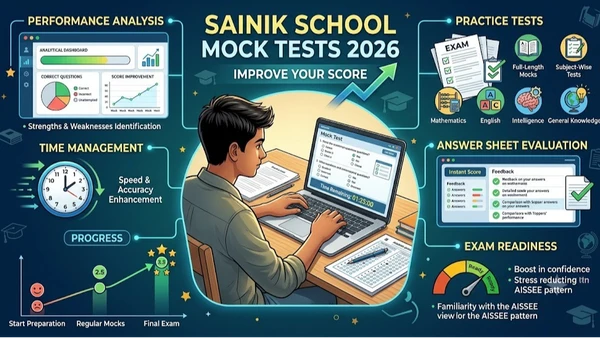
Mock tests for the Sainik School entrance exam 2026 are created strictly following the latest AISSEE exam pattern so that students can prepare their best. By practicing these tests, students can improve their accuracy, speed, and confidence by the time of their examination.
The mock test environment should replicate exam day as closely as possible. Same timing. Pencil on OMR sheet. No phone. No interruptions. No peeking at notes. A mock test taken casually at the kitchen table while the TV is on teaches nothing useful about actual exam performance.
The Right Way to Take a Mock Test
Before the test: Set a timer for exactly 150 minutes (Class 6) or 180 minutes (Class 9). Keep water nearby but no food. Put the phone in another room. Tell family members not to interrupt.
Learn to allocate time across sections to avoid rushing through questions. Practice with timed mock tests to simulate exam conditions.
Decide section timing in advance. For Class 6 - roughly 60 minutes for Mathematics, 30 minutes for Language, 30 minutes for GK, 30 minutes for Intelligence. Adjust based on your child's strengths. But have a plan before the timer starts. Don't let Mathematics eat into GK time without realising it until the last 10 minutes.
During the test: Attempt every question. There is no negative marking. A blank answer guarantees zero. A guessed answer has a chance. For questions your child is genuinely unsure about - eliminate obviously wrong options first, then make the best guess from remaining choices.
Mark questions that feel uncertain as you go. If time remains at the end, revisit those first.
After the test: Don't just check the score. The score is not the lesson. The lesson is in every question that was wrong - and in every question that was guessed correctly but for the wrong reason.
The Review Process That Actually Improves Scores
Review every wrong answer. Don't just check the score. Understand why the mistake happened. Was it a silly error? A concept gap? Time pressure? Each mistake tells you something important.
Go through every wrong answer in three steps:
Step 1 - Categorise the error. Was it a careless mistake (read the question wrong, miscalculated, ticked the wrong option)? A concept gap (didn't know the method)? Or a time pressure error (knew it but rushed)?
Each category needs a different fix. Careless mistakes need slower, more careful reading habits. Concept gaps need targeted revision of that specific topic. Time pressure errors need better section-wise time planning in the next mock.
Step 2 - Find the root. For concept gap errors, don't just read the correct answer and move on. Go back to the NCERT chapter or coaching book section covering that topic. Re-read it. Redo similar problems until the method is clear.
Step 3 - Record it. Keep a dedicated "error notebook." One page per mock test. Date at the top. List every wrong answer with: subject, topic, type of error, and what the correct approach was. Review this notebook before every subsequent mock test.
Toppers' preparation for AISSEE includes several mock tests - one is not enough. To succeed in the AISSEE 2026, students should give at least 5 mock tests at some intervals and make improvements. Revision is one tip from the toppers' strategy.
After 5 or 6 mock tests with this review process, patterns emerge. The same topics keep appearing in the error notebook. Those are the topics that need dedicated extra revision - not the entire syllabus again, just the specific chapters that are consistently producing wrong answers.
How Many Mock Tests to Take and When
Take weekly mock tests under timed conditions. Analyze mistakes after each test to identify weak areas and reinforce learning.
This is the right frequency for most of the preparation year - one full-length mock per week from months 5 or 6 onward. That's roughly 20 to 25 full mock tests over the preparation period. Combined with the review process above, 20 to 25 well-reviewed mocks transform preparation more than 100 unreviewed ones.
In the final 30 days before the exam, increase frequency to 2 to 3 full-length mocks per week. The goal in this phase isn't learning - it's building the mental stamina to maintain focus and accuracy for 150 or 180 minutes under pressure.
One mock test won't change anything. But ten tests? Twenty tests? That builds real exam confidence.
Don't take mocks every single day in the final month. Rest days matter. A child who sits mock tests 7 days a week for 4 weeks arrives at the actual exam mentally exhausted. Two to three mocks per week with review days in between is both more effective and more sustainable.
Section-Specific Mock Test Strategy
Mathematics - The Highest-Weightage Section
Prioritize high-weightage sections like Mathematics during preparation.
Mathematics covers 50 questions worth 150 marks in Class 6. This section alone is half your total score.
To score high in Mathematics, focus on understanding the concepts and then try the mock tests, setting a timer. Speed in Mathematics comes from internalising methods - not from rushing. A child who has genuinely understood how to set up a ratio problem solves it faster than one who is trying to remember a formula under pressure.
In mock test review, Mathematics errors deserve the most time. Every wrong Mathematics question traces back to a specific concept gap. Find it, fix it, and test it again in the next mock.
Intelligence - The Section Most Children Underestimate
Intelligence covers pattern finding, series completion, analogies, coding-decoding. This section isn't taught in regular school. Many students struggle here.
Intelligence improves through pattern recognition - which develops with repeated exposure to question types, not theory reading. Use sectional Intelligence mock tests in addition to full-length mocks. 20 Intelligence questions timed at 15 minutes, reviewed carefully, two or three times per week - that builds the pattern recognition speed that full mock tests alone don't develop efficiently.
General Knowledge - The Daily Reading Section
GK is the section that rewards habits built over months, not cramming done in weeks. Watch the Geographical Channel to improve general knowledge. Stay away from YouTube and other social networks as these are the biggest distractions.
In mock test review, note which GK topics are producing consistent wrong answers. Are they current affairs? Indian geography? Science GK? Defence-related GK? The error pattern tells you where to focus daily reading in the weeks ahead.
Where to Access Good Mock Tests
AISSEE mock tests should mirror the real exam exactly - same pattern, same difficulty, same time limits. Master the exam by solving real AISSEE papers from 2018 to 2024. These are ideal for final revision.
Previous year AISSEE question papers from 2018 to 2025 are the gold standard. They're not replications - they are actual exam papers. Solving them tells you more about the real exam than any mock test series created by a coaching institution.
AISSEE mock tests for Class 6 and 9 target subjects based on their syllabi, allowing students to focus on Mathematics, English, General Knowledge, and Intelligence, aligning with AISSEE requirements. Detailed feedback provided after mock tests aids in understanding areas needing improvement.
SainikGuru.com's free mock test portal at sainikguru.com/tests/ provides AISSEE-pattern mock tests for both Class 6 and Class 9 with automatic performance tracking. The platform saves every attempt's data - which topics were missed, which concept categories are weak - so improvement is measurable across tests over time.
The mock test isn't the preparation. It's the measurement tool. Use it correctly - under exam conditions, with full review afterward, consistently over months - and it becomes the most powerful improvement tool in your child's AISSEE preparation.
For free AISSEE mock tests, previous year papers, and complete Sainik School preparation resources, visit SainikGuru.com.