
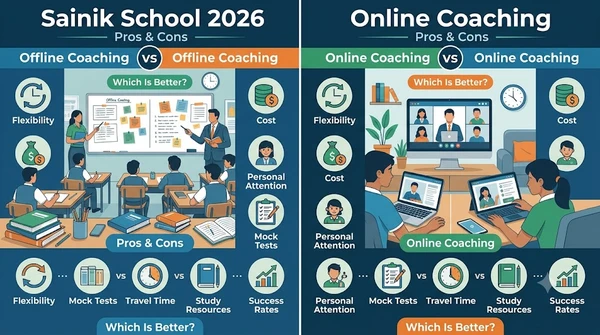
Anita from Bhopal called last month with a straight question. Her son Dhruv was in Class 4 and they'd started thinking about AISSEE ↗ early - which is good. But she was confused.
"Online karaun ya offline? Sab kuch available hai, aur sab waale bolta hai unka better hai."
She wanted an honest answer. Not a sales pitch.
So here it is.
First - What This Exam Actually Demands
Before picking a coaching mode, understand what the AISSEE 2026 tests.
Speed. Accuracy. Consistent revision. Pattern recognition. Maths carries half the paper - 150 of 300 marks for Class 6, 200 of 400 for Class 9. This isn't a test you can crack in a one-month sprint. It rewards students who practise steadily over months.
So the real question isn't online vs offline. It's - which mode keeps your child working consistently?
That's the frame. Keep it in mind.
What Offline Coaching Does Well
Dhruv's father was clear about one thing. "Ghar pe baitha hai toh mobile pe chala jaata hai. Classroom mein jaata hai toh padhta hai."
That's the honest truth about offline coaching. It enforces a routine. When a child gets dressed, leaves the house, sits in a classroom with other kids, and has a teacher asking questions - the discipline is built-in. No willpower required.
Offline also wins on two specific things:
Peer pressure (the useful kind). When your child sees another student solve a Maths problem faster, something clicks. Competition in a physical space is more real than any leaderboard on an app.
Doubt clearing in the moment. Hand goes up, teacher explains, move on. This back-and-forth is faster and more natural in a classroom. Especially for younger children - Class 4, 5 - who don't always know how to type out what they're confused about.
Where offline struggles - quality varies wildly by city and by centre. A Sainik School coaching institute in Dehradun with 28 years of results is not the same as a local tuition centre that added "defence coaching" to its signboard last year. Batch sizes in many offline centres run to 40-50 students. The child at the back? Often invisible.
And then there's travel. A 10-year-old sitting in an auto for 45 minutes each way - that's 90 minutes of daily preparation time gone.
What Online Coaching Does Well
Sainik School online coaching has one massive, underrated advantage - recording.
Miss a class? Rewatch it. Didn't understand fractions on Tuesday? Watch the explanation again on Thursday night, pause it, rewind. No offline class in the world offers that. The topic doesn't move on without your child.
Small batch sizes - properly run online programmes keep these tight. Twelve to fifteen students per live session, where the teacher can actually see every face on screen. Compare that to forty kids in a classroom where the teacher's back is often to the board.
Online also costs less. Travel gone. Hostel unnecessary. Study material digital. For a family in a small town - Sagar, Shimla, Silchar - where there is no good AISSEE coaching centre nearby, online isn't a compromise. It's the only good option available.
But here's the honest limitation.
A child who struggles with self-discipline - who will keep YouTube open in another tab, who needs physical presence to stay on task - that child will underperform in online mode. The mode is only as good as the student's ability to use it honestly.
Side-by-Side Comparison
|
Factor |
Offline |
Online |
|
Discipline |
Built-in from environment |
Depends on child's self-discipline |
|
Doubt clearing |
Instant, face-to-face |
Slightly delayed, but text + video available |
|
Class recordings |
Rarely available |
Standard feature |
|
Batch size |
Often 30-50 students |
Smaller, 10-20 in good institutes |
|
Cost |
Higher (transport + fees) |
Generally lower |
|
Availability |
City-dependent |
Available pan-India |
|
Peer competition |
Strong and visible |
Leaderboards and mock rankings |
|
Parental visibility |
Teacher meetings, physical report |
App dashboards, digital tracking |
So Which One Is Actually Better?
Neither. Fully honest answer.
If your child is self-motivated, sits at a desk without being pushed, and you live far from a good coaching centre - online coaching works excellently.
If your child drifts without external structure, responds better to a physical classroom, or if you have a strong institute nearby with a real track record - offline coaching is the right call.
And if you're still not sure - try before you pay. Any decent Sainik School coaching institute today should offer a free demo period, online or offline. Fifteen days of actual classes - not one sample session - before you commit.
Anita enrolled Dhruv online, by the way. Live classes, small batch, recordings available. His father sits near him for the first 10 minutes each session - then leaves. That's their system. Twelve weeks in, Maths scores up by 40%.
The mode doesn't win exams. The routine does.