
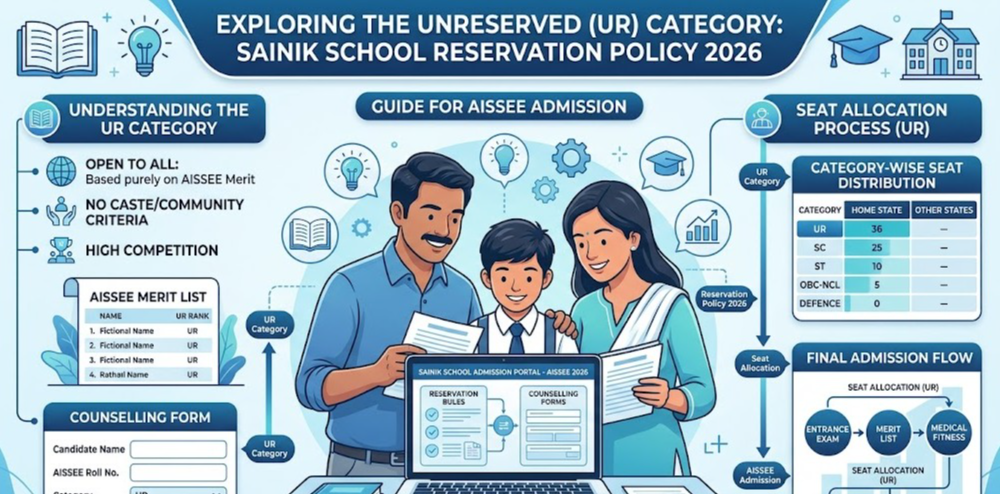
General category. Unreserved. UR. These terms get used interchangeably in the context of Sainik School admission ↗ - and most parents treat them as meaning the same thing.
They don't. And the difference matters when you're trying to figure out how many seats your child is actually competing for.
Here's the complete picture.
How Seats Are Distributed Before the UR Category Appears
The Sainik School seat reservation structure works in layers. Understanding the layers is the only way to understand what "General category" or "Unreserved" actually means in the context of available seats.
Layer 1 - Home State vs Other State split
67% of the seats are reserved for candidates domiciled in the State or UT where the Sainik School is located. 33% of the seats are reserved for candidates from Other States and Union Territories.
This split happens first. Before any social category reservation, the total seats at a school are divided into a home-state pool and an outside-state pool.
Layer 2 - SC, ST, and OBC-NCL reservations within each pool
Within both the home-state pool and the outside-state pool, the following reservations apply:
15% of the seats are reserved for candidates belonging to the SC category. 7.5% for the Scheduled Tribe category. 27% for Other Backward Classes belonging to the Non-Creamy Layer as per the central list. Thus, 49.50% of the seats in Sainik School are reserved on these lines.
So after SC, ST, and OBC-NCL reservations, 50.50% of total seats remain.
Layer 3 - Defence category reservation from the remaining pool
Out of the balance 50.50% of the seats in the Home State and Other States quota, 25% of the seats are reserved for the wards of defence personnel - serving personnel of Indian Army, Indian Air Force, Indian Navy - and ex-servicemen.
25% of 50.50% works out to roughly 12.625% of total seats going to the Defence category.
What Remains Is the UR Pool
After SC (15%), ST (7.5%), OBC-NCL (27%), and DEF (25% of the remaining 50.50%) - what's left is the Unreserved or General category pool.
That comes out to approximately 37.875% of total seats available for UR candidates within each quota (home-state and outside-state separately).
So at a school with 90 total seats - 60 in home-state quota and 30 in outside-state quota:
- Home-state UR pool: roughly 23 seats
- Outside-state UR pool: roughly 11 seats
That's what General category candidates from home state and outside state are actually competing for. Not 90 seats. Not 60. Around 23 home-state UR seats and 11 outside-state UR seats.
What "Unreserved" Actually Means - and Doesn't Mean
This is where many families misread their situation.
"Unreserved" does not mean open to everyone. It means the seats in that pool are filled purely on merit - no additional reservation applies within the UR pool itself. The strongest-scoring UR candidates get those seats in order of rank.
It also does not mean that SC, ST, or OBC-NCL candidates cannot occupy UR seats. If a reserved-category candidate's score is strong enough to qualify on pure merit within the UR pool, they can be counted there instead of their reserved category seats. This actually benefits reserved-category candidates with strong scores - they don't "use up" a reserved seat if they can compete on merit.
Reservation in Sainik Schools ensures that students from various backgrounds - state quotas, social categories, children of defence personnel, girls - get fair chances and that seats are not monopolised by any one group.
The UR category exists precisely to fill seats based on merit after all reservation commitments are met. It's the competitive open pool.
The Minimum Qualifying Mark for UR Category
General category students must score at least 45% marks along with meeting the cut off marks.
For Class 6 out of 300 marks, that's 135 marks minimum. For Class 9 out of 400 marks, that's 180 marks minimum. Meeting this floor makes a candidate eligible - but it doesn't mean they're anywhere near the competitive cut off for UR seats at most schools.
Candidate should have scored more marks than the total marks scored by the last candidate admitted in the relevant category at the school applied for.
That last sentence is the real benchmark. Not the minimum percentage. Not a national average. The marks of the last candidate admitted in the UR category at your specific school, in your domicile quota - that's the actual competitive threshold you need to clear.
How UR Seats Interact With Girl Reservations
One more layer that affects General category families with daughters applying for Class 6.
10% of the strength of Class VI or 10 seats - whichever is higher - are reserved for girls in any school, to cater to all the categories. One seat per category for girls is allotted in the Girls admission.
This means within the UR pool, a portion is carved out specifically for girl candidates in Class 6. Boys and girls in the General category compete within separate pools for Class 6 seats. The sequence of seat allocation for boys and girls of Class VI will be separate as category tags and gender tags are different and seats are gender-wise in existing Sainik Schools.
For Class 9, the situation is different. For Class 6, 10% of the seats are reserved for girls. There is no fixed percentage of seats for girls in Class 9. Class 9 girl admissions happen subject to vacancy - no fixed reservation applies.
What Happens When UR Seats Go Unfilled
Not all UR seats fill every year at every school. The policy for handling vacancies is systematic.
Remaining deficiencies in all categories after the internal transfer of vacancies may be filled up by candidates on the waiting list of other Sainik Schools.
If UR seats in the outside-state quota go unfilled, they can be redistributed toward home-state candidates in the same category. If any reserved categories - SC, ST, or OBC-NCL - are not available within the Home State, the seats shall be distributed among the available categories within the Home State in order that 67% of the seats remain with the Home State.
This redistribution happens progressively across counselling rounds. A school that shows no available UR outside-state seats in Round 1 might show 2 or 3 by Round 3 as other quota seats are redistributed.
A Practical Example to Make This Concrete
Say a school has 100 total seats. The home-state pool gets 67 seats.
Within those 67 home-state seats:
- SC: 15% = ~10 seats
- ST: 7.5% = ~5 seats
- OBC-NCL: 27% = ~18 seats
- Remaining after SC/ST/OBC: ~34 seats
- DEF: 25% of 34 = ~8 seats
- UR (General): ~26 seats
Now apply the gender split for Class 6. 10% of total strength or 10 seats for girls - whichever is higher. Say 10 girls' seats are carved from the UR pool. That leaves roughly 16 UR General category boys' seats in the home-state pool.
Parents with defence backgrounds should note that proper documentation proving their service status will be required during the admission process. And OBC candidates must verify eligibility from the central list. State lists for OBC may differ from the central list used for Sainik School admission.
Those last two points catch people off guard every year. An OBC certificate from your state authority is not automatically valid for Sainik School admission - it must align with the central OBC-NCL list. Check before the document verification stage, not at it.
What This Means for Your Counselling Strategy
If your child is in the UR General category, the key number to find for any school is not the total seats - it's the UR seats in your specific domicile pool after all other reservations are applied.
That number is smaller than most parents expect. And competition within it is concentrated because every other unregistered, well-prepared General category candidate from your state is competing in the same pool.
This is why the seat matrix on the AISSAC portal is so important. Candidates are advised to make a tentative list according to their preference of schools after going through the seat matrix uploaded on the portal before choice filling and locking. The seat matrix breaks down category-wise vacancies. Find the UR row. Match it to your domicile. That's your real competitive pool size - and it tells you more about your realistic chances than any broad cut off range ever will.