
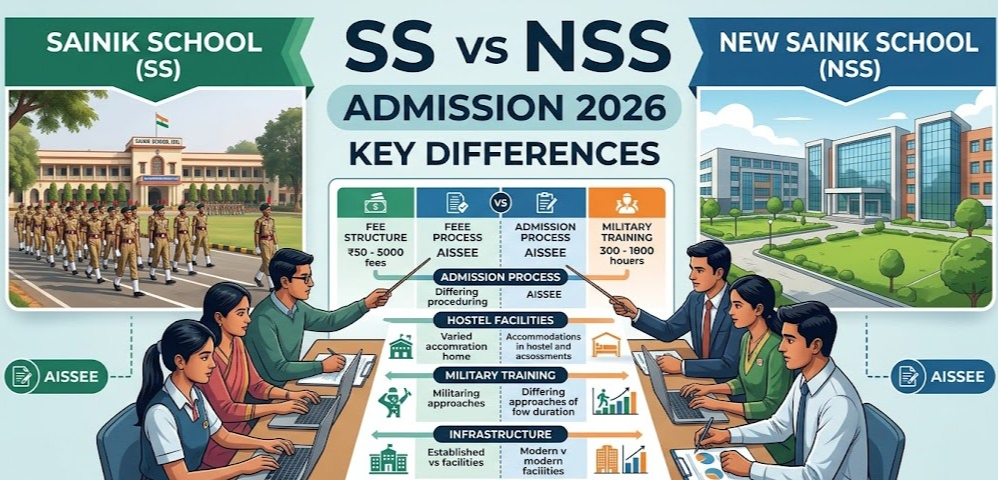
A parent recently wrote in a forum: "We got allotted a New Sainik School. Is it as good as the real ones?"
That question shows up constantly. And the fact that it's being asked tells you something important - most families don't fully understand what New Sainik Schools are, how they differ from the original 33, and whether the difference actually matters for their child.
Here's an honest breakdown of both.
What They Are - The Basic Distinction
Old Sainik Schools - the original 33 - are fully government-run, directly managed by the Sainik Schools Society under the Ministry of Defence. They've been operating since the 1960s. The infrastructure, staff qualifications, hostel facilities, and academic oversight all follow a uniform standard set by SSS.
New Sainik Schools came in under a Public-Private Partnership model announced by the government in 2021. New Sainik Schools are schools operated in partnership with NGOs, private schools, or state governments. The scheme leverages public-private partnership in education to tap into existing infrastructure with reputed private and government schools and open up new capacities to meet the growing aspirations of children desirous of receiving a Sainik School pattern of education.
NTA conducts AISSEE ↗ for admissions to Classes 6 and 9 in 33 existing Sainik Schools and 19 approved New Sainik Schools across the country.
Same exam. Same counselling portal. But two very different types of schools behind those slots on the AISSAC choice list.
Admission Process - Similar but Not Identical
Both types of schools use AISSEE marks for admission. Both appear in the AISSAC portal. Both require medical fitness. On the surface, the pathway looks the same.
But NSS admission has a structural difference that most parents miss entirely.
For New Sainik Schools, 40% of seats will be filled based on the rank secured by candidates in AISSEE 2026, with no domicile or category reservation considered. 60% of the seats will be filled by those who are currently studying in any of the approved New Sainik Schools, based on rank secured in the school merit list, with domicile and category reservation not considered.
That 60% internal quota is significant. If a child is already enrolled in a New Sainik School - attending it as a regular day school before the AISSEE route opens - they have priority access to 60% of Class 6 seats through an internal merit list. The remaining 40% is what outside AISSEE candidates compete for through the counselling portal.
For families applying purely through AISSEE, you're competing for the 40% external quota at NSS schools - not the full seat count. Keep that in mind when looking at the seat matrix.
Fees - A Wide and Honest Difference
This is one of the biggest practical differences between the two types.
Old Sainik School fees structure 2026 ranges from Rs 1.3 lakh to Rs 1.9 lakh annually for various schools. Usually, Sainik School fees increase by 10% every year as per Sainik Schools Society rules and regulations. Fees structure for General, Defence, and SC/ST categories is different - SC/ST students pay the least due to subsidies designed by the Ministry of Defence and Sainik Schools Society.
Defence category families get fee concessions. SC/ST families get further subsidies. The fee structure at Old Sainik Schools is standardised, SSS-governed, and publicly declared.
New Sainik Schools are a completely different story. The fee structure, education board, and language of instruction of approved New Sainik Schools differ from school to school.
Some NSS schools charge significantly more than Old Sainik Schools. Some are comparable. A few are actually more affordable. There is no central fee cap imposed by SSS on NSS fees - each school sets its own structure based on its own costs and management decisions.
Don't decide based only on tuition fee. Always ask for the all-inclusive annual cost - tuition plus boarding or day boarding, pocket and incidental charges, uniform, books, training kit, and deposits.
Before accepting an NSS allotment, get the full cost breakdown from the school directly. Don't rely on what any third-party website says - fees change, and what you find online may be a year or two old.
Boarding vs Day School - A Critical Factor
Every Old Sainik School is a fully residential institution. Your child lives there, eats there, trains there. The residential model is inseparable from the Sainik School identity - the discipline, the physical training schedule, the structured daily routine all flow from the fact that it's a full boarding school.
New Sainik Schools vary. Some are fully residential. Some offer day-boarding options. A few are essentially day schools with a Sainik-pattern curriculum. The fee model and boarding type vary a lot across New Sainik Schools - parents must compare carefully.
This matters enormously if the reason you want a Sainik School is the residential experience - the independence, the structured life, the collective training environment. An NSS that runs as a day school doesn't offer that, regardless of what it calls itself.
Before accepting any NSS seat, specifically ask: Is this school fully residential? What does a typical day look like? Do students live on campus?
Education Board and Language of Instruction
Old Sainik Schools follow CBSE. Uniformly. Every school, every class. The medium of instruction is English.
The education board and language of instruction of approved New Sainik Schools differ from school to school. Some NSS schools are affiliated with CBSE. Some with state boards. Some with ICSE. The medium of instruction may be English, Hindi, or a regional language depending on the partner institution.
For families who are planning for NDA preparation from Class 6 onward - which is the whole point of Sainik School education for many - the board and medium matter for long-term continuity. CBSE alignment with English medium is the most NDA-compatible pathway. An NSS running on a state board in a regional medium is not the same preparation environment.
Infrastructure and Training Quality
Old Sainik Schools have standardised physical training facilities - parade grounds, gymnasiums, NCC integration, cadet training structures. The quality varies between schools but the framework is consistent and SSS-mandated.
New Sainik Schools depend on their partner institution's existing infrastructure. A New Sainik School set up within an established, well-resourced private school may have excellent facilities. One set up within a smaller institution may not. There's no uniform infrastructure standard enforced by SSS across all NSS schools the way there is for Old Sainik Schools.
The best practical approach is to ask the school directly: Is admission through AISSEE and counselling for 2026-27? What is the daily routine - PT time, study hours, lights-out time? What is the total annual cost all-inclusive?
Those three questions reveal more about whether an NSS is right for your child than any ranking or third-party review.
Reservation Rules - Different for NSS
Old Sainik Schools apply the full reservation framework - 67% home state, 33% outside state, SC/ST/OBC-NCL/DEF sub-categories within each pool, girls' quota in Class 6.
For New Sainik Schools, no domicile or category reservation is considered in either the 40% external AISSEE route or the 60% internal route. Seats are filled purely on merit.
This is actually an advantage for some families. A candidate from a category with strong competition in the Old Sainik School reserved pool may find the NSS pure-merit route more navigable. And a candidate from outside the state where an NSS is located doesn't face the 33% outside-state cap - because NSS admission through the 40% AISSEE route uses pure national merit.
The Bottom Line
Old Sainik School and New Sainik School are not equivalent - and they're not entirely different either. The entrance exam is the same. The aspiration behind applying is the same. The Sainik pattern of education - discipline, physical training, leadership development - is the common thread.
But boarding status, fees, board affiliation, infrastructure quality, and reservation rules differ meaningfully. Don't accept an NSS allotment without knowing exactly what that specific school offers - not what "New Sainik School" generically sounds like.
Visit the school's official website. Call the admissions office. Ask the three questions above. Then decide.