
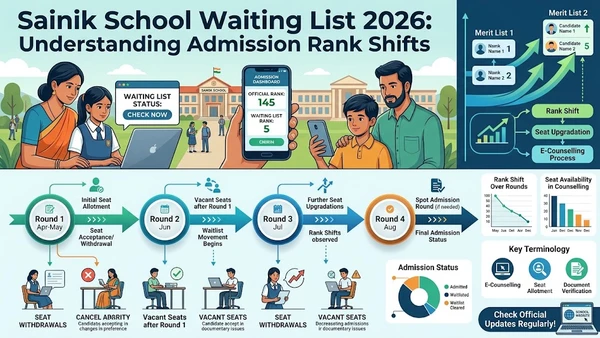
Being on the Sainik School waiting list feels like being told you're almost there - but not quite. And then the rounds come and go, some families get seats, and the ones still waiting don't know whether to keep hoping or accept it's over.
The waiting list in AISSAC 2026 is not a passive system. It's a live queue that changes after every counselling round. Understanding why it changes - and what you need to do to benefit from those changes - is what separates families who eventually get a seat from families who were on the list but fell through the cracks.
Here's how it actually works.
What "Waiting List" Means in AISSAC
First, a clarification. AISSAC doesn't publish a single national waiting list with numbered positions. The waiting list is implicit - it's your position in the merit list below the last candidate who was allotted a seat in Round 1 at each specific school, in your specific category and domicile pool.
The Sainik School waiting list can be checked on the official portal, pesa.ncog.gov.in, by clicking on the "counselling process" tab on the homepage. It will be released in April/May after AISSEE ↗ 2026 results.
Your rank relative to the cut off - not a labelled "waiting list number" - tells you how close you are. If the Round 1 cut off at your home state school in General category was 235 marks and your child scored 228 - you're 7 marks below the cut off. That's your effective waiting list position. How far that 7-mark gap is from a seat depends on what happens in subsequent rounds.
Four Things That Open Seats and Shift Ranks
The waiting list moves every round because seats become available for several specific reasons.
Reason 1 - Candidates choose Reconsider.
Once you are allocated a seat and you have opted for reconsideration, your accepted seat from the earlier round will be automatically cancelled and you cannot get the previously allotted seat.
Every time a candidate in Round 1 or Round 2 decides to reconsider - hoping for a better school in the next round - the seat they were holding returns to the pool. If that seat was at a school where you're on the waiting list, your rank moves up. The reconsider rate is significant. Many families gamble on a better school in later rounds, returning seats to the pool consistently across cycles.
Reason 2 - Candidates choose Exit.
A candidate who formally exits the counselling process - or who doesn't respond within the round deadline and is treated as having exited - releases their seat entirely. If you do not report to the allocated school before the last date as per timeline, it will be considered that you are not interested in joining the school and the allotted seat will be cancelled. Non-reporting and non-responding candidates create vacancy that flows to the next rank on the waiting list.
Reason 3 - Medical failures.
Candidates who were allotted seats and accepted them must then pass the medical examination. Those who fail the medical - regardless of how strong their written score was - lose the seat. That vacancy re-enters the available pool for the next round of allotment.
Reason 4 - Fresh registration in Round 2.
Fresh registration is available in the 2nd Round for candidates who have not registered in the 1st Round of Counselling. Freshly registered candidates need to fill choices. New candidates entering in Round 2 can sometimes create indirect movement - if they take a seat that a Round 1 candidate was about to receive in Round 2, that Round 1 candidate may reconsider and release their earlier seat.
How Many Rounds and When Do They Run?
The final merit list for AISSEE 2026 is expected to be published in May 2026 after the completion of medical exams.
AISSAC typically runs 4 to 6 rounds before the counselling cycle closes. Each round runs on a defined timeline - candidates receive allotment notifications, respond through the portal with Accept, Reconsider, or Exit, and the next round processes new allotments from the resulting vacancies.
Round 1 results for AISSEE 2026 were declared on 5 April 2026. Subsequent rounds follow based on how quickly families respond and how many seats vacate per round. The counselling cycle typically runs through May and into early June for the academic year starting July.
The waiting list is most active between Round 1 and Round 3. After Round 3, the rate of seat availability typically slows as the remaining candidates who haven't accepted or exited are a smaller, more committed pool. By Round 5 or 6, the seats that remain are genuinely residual - the very last vacancies before the cycle closes.
What You Must Do to Stay in the Race
This is where many waiting list families make a critical mistake. They check the portal after Round 1, see no allotment, and disengage. They assume no news means no movement. Then they miss the response window for a Round 3 allotment because they weren't checking the portal.
If you do not report to the allocated school before the last date as per timeline, it will be considered that you are not interested in joining the school and the allotted seat will be cancelled. The same principle extends to the portal response window - if a seat is allotted in any round and you don't respond within the given timeframe, the system treats it as Exit.
Log into pesa.ncog.gov.in/sainikschoolecounselling every single day during active counselling rounds. Not every few days. Every day. Round notification windows are short - sometimes 48 to 72 hours - and missing the window is permanent. There are no exceptions for families who "didn't know" the round had opened.
Keep all documents ready now. Not after an allotment appears - now. When a seat drops in Round 3 or 4, the timeline from allotment to medical to school reporting is compressed. A family that has their domicile certificate, birth certificate, category certificate, and medical form ready moves immediately. A family that needs to collect documents after the allotment may run out of time.
A Realistic Assessment of Waiting List Chances
If some reserved seats are left unfilled - for example, no candidate in ST or no girl applicant in some category - they may be reallocated to other categories or among quotas following rules.
Waiting list success depends heavily on how close to the cut off your child's score sits, and across how many of your 10 preferred schools you're near but just below the cut off.
A child 5 to 10 marks below the Round 1 cut off at multiple schools has a realistic chance across multiple rounds. Reconsidering candidates, medical failures, and non-reporting above them in the list can absolutely close a 5 to 10 mark gap - particularly in categories with small pools and at schools where medical failure rates tend to be higher due to stricter physical standards.
A child 30 or 40 marks below every cut off on their list is in a much harder position. The volume of seats that would need to vacate above them to reach their rank is significant. It's not impossible - particularly if the list includes lower-cut-off schools like Kapurthala or Northeast schools - but it's genuinely unlikely by later rounds.
The Sainik School waiting list 2026 - order of filling vacant seats, steps to check, single school choice waiting list, limitations and conditions - is on the official portal. Check it school by school, not as a national aggregate. Your position at School A may be much closer to an allotment than your position at School B. Focus energy on schools where the gap is smallest.
When to Accept and When to Keep Waiting
This is the judgment call that sits at the heart of the waiting list experience.
If your child receives an allotment in Round 2 or Round 3 at their 6th or 7th preference school - do you accept it and lock in the seat, or reconsider and hope Round 4 brings something better?
Once you are allocated a seat and you have opted for reconsideration, your accepted seat from the earlier round will be automatically cancelled and you cannot get the previously allotted seat.
The reconsider is irreversible. The seat you release is gone. Whether Round 4 gives you something better depends on what vacates between now and then - which you cannot predict.
The general principle: the later you are in the counselling cycle, the more cautious you should be about reconsidering. A Round 2 allotment in Round 3 still has several more rounds ahead where vacancies can improve the offer. A Round 4 allotment reconsidered in Round 5 has very little room left before the cycle closes.
Accept a decent allotment when it arrives, unless you have a specific reason to believe a significantly better school is within reach in the very next round. Chasing a top-choice school through reconsider in Round 5 and ending up with nothing in Round 6 is the worst outcome the waiting list process produces - and it happens every year to families who mistimed the decision.