
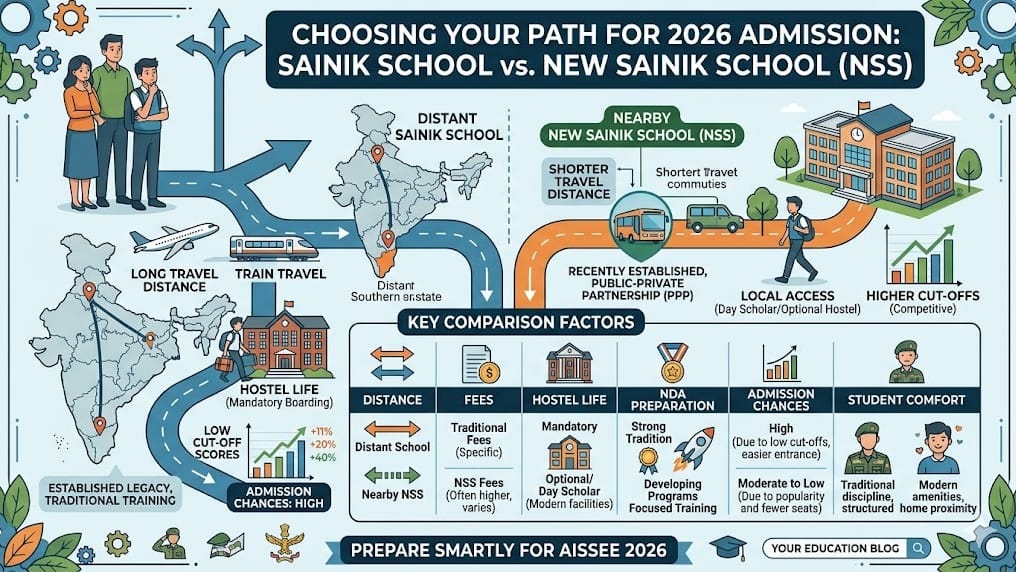
Picture this. Round 1 AISSAC results come out. Your child has been allotted a seat - but not at any of the schools you were hoping for. Two options are sitting in front of you.
Option A: Sainik School Kapurthala. 700 kilometres from your home in Maharashtra. Old Sainik School. Fully residential. Low cut off - your child's score cleared it comfortably. Proven NDA preparation environment.
Option B: A New Sainik School 35 kilometres from your city. Closer. More accessible for visits. Fees slightly lower. But it's an NSS, and you're not entirely sure what that means for your child's future.
This is one of the most common decisions parents face in AISSAC 2026. And there's no universal right answer - but there is a clear thinking framework.
Distance Is a Real Factor, Not a Weakness to Overcome
The advice that circulates in most parent groups is: distance doesn't matter, Sainik School is Sainik School, send the child wherever they get in.
That advice isn't wrong exactly. But it oversimplifies something real.
A child entering residential school at age 10 or 11 is leaving home for the first time. Some children adapt within weeks. Some take an entire year before they settle. The adjustment period - the initial phase of homesickness, unfamiliarity, and longing - is almost universal to some degree.
Distance affects how that adjustment period plays out in a practical sense. A child 400 kilometres away can be visited by parents on long weekends and holidays with reasonable effort. A child 1,200 kilometres away gets parental visits 2 or 3 times a year. During the adjustment period, the frequency and ease of parental visits affects how quickly the child settles.
AISSEE ↗ 2026 covers admission to 33 Old Sainik Schools and 38 approved New Sainik Schools across the country. With that many schools across India, geography isn't a trivial consideration. Choosing between a school in your home region and one across the country is a real choice with real consequences for a child starting at Class 6.
None of this means never choose a distant school. It means factor distance into the decision honestly, alongside everything else.
What Low Cut Off at an Old Sainik School Actually Signals
When a school has a lower AISSEE cut off than peer schools, the first instinct of many parents is to wonder why. Is something wrong with it? Why is it less competitive?
Usually nothing is wrong. The cut off difference almost always comes from one of three reasons:
Sainik Schools in lower-population states or states with fewer AISSEE applicants typically see lower cut offs because the home state applicant pool is smaller and less competitive, not because the school is inferior.
Schools like Sainik School Kapurthala in Punjab consistently maintain lower cut offs among Old Sainik Schools - General category candidates from the home state fall between 200 and 250 marks. Punjab has excellent AISSEE coaching infrastructure but also has a comparatively smaller competing pool than Maharashtra or UP. The school itself is a full Old Sainik School with the complete residential programme, daily PT, CBSE board, and NDA preparation culture.
A low cut off Old Sainik School - particularly one that is geographically distant - is often a genuinely strong school that simply has fewer local applicants. From a quality perspective, choosing it over a nearby NSS may well be the better long-term decision for a child targeting NDA.
What Nearby NSS Actually Offers - And Doesn't
The nearby NSS's biggest advantage is proximity. Full stop. The school's quality - residential status, daily PT, board affiliation, Sainik culture depth - is something you have to verify independently.
Don't assume NSS equals hostel. Some NSS schools are fully residential, some are day-boarding, some are mixed.
The fee structure, education board, and language of instruction of approved New Sainik Schools differ from school to school.
If the nearby NSS is:
- Fully residential ✓
- CBSE board, English medium ✓
- Running daily physical training and parade ✓
- Has been in the Sainik vertical for 3+ years with developing NDA culture ✓
Then the nearby NSS comparison with a distant Old Sainik School becomes genuinely competitive. The proximity benefit is real. The institutional quality is verified. The choice becomes legitimately close.
If the nearby NSS is:
- A day school or day-boarding only ✗
- State board affiliated ✗
- PT twice a week, not daily ✗
- NSS approval received in 2024 with no established Sainik culture ✗
Then the distant Old Sainik School is clearly the stronger choice for a child who genuinely wants the Sainik School experience - especially for NDA aspirants. The proximity convenience doesn't compensate for the institutional gap.
Running the Comparison - A Simple Framework
Here's a side-by-side thinking framework before you decide.
For the distant Old Sainik School, ask:
- How far exactly? What does a visit require - train, flight, road?
- How often can you realistically visit per year?
- Has your child been away from home before - camp, hostel, residential programme?
- What is this school's track record on NDA and defence career outcomes?
For the nearby NSS, ask: Is admission through AISSEE and counselling for 2026-27? What is the total annual cost all-inclusive - tuition plus boarding or day boarding, pocket and incidental charges, uniform, books, training kit, and deposits? What is the daily routine - PT time, study hours, lights-out time?
Additionally:
- Is the school genuinely residential?
- How many years has the Sainik School vertical been running here?
- What board and medium of instruction?
- What NCC integration exists?
The NDA Lens - Which School Actually Prepares Better?
If your child's goal is NDA - and this is the reason you're in the Sainik School process at all - the evaluation is clear.
Old Sainik School students tend to perform better at the SSB interview because they have already developed leadership presence through group activities, leadership roles, and exposure to structured decision-making scenarios. The residential environment is central - students live, eat, train, and compete together daily from Class 6 onward.
A distant Old Sainik School with low cut off still offers this full residential environment. Six years of that formation - parade, PT, NCC, competitive academics, peer leadership - is what arrives at NDA.
A nearby NSS that is residential and physically active can offer a version of this. Less established, yes. But a child who is settled, regularly visited, and thriving in a decent NSS environment may outperform a child who is unsettled and struggling 900 kilometres from home - regardless of institutional prestige.
The honest answer is: for NDA preparation, the Old Sainik School wins on institutional quality. But institutional quality only translates to outcomes if the child is thriving in the environment. A child who is genuinely miserable for two years at a prestigious distant school is not being served well by that choice.
How to Make the Final Call
Four questions that cut through the uncertainty:
One - Is your child the kind of person who adapts quickly to new environments, or someone who needs the stability of family proximity during adjustment?
Two - Is the nearby NSS genuinely residential, CBSE-affiliated, and running a credible daily PT programme?
Three - What's the distance, and how often can you realistically visit?
Four - Is your child's NDA aspiration firm enough that the institutional quality difference between Old Sainik School and a weaker NSS actually matters to them right now?
If your child is adaptable, the distant Old Sainik School is the stronger choice. If your child genuinely needs proximity in early years AND the nearby NSS passes the residential/PT/board checklist - the nearby NSS is a defensible, reasonable choice that doesn't have to be regretted.
What you shouldn't do is make this decision based on the name alone - either direction. Not all Old Sainik Schools are equally good. Not all NSS schools are equally weak. The specific schools, the verified facts about each, and your child's actual personality all go into this call together.
For school-specific residential verification, distance-wise Sainik School comparisons, and complete AISSAC 2026 strategy, visit SainikGuru.