
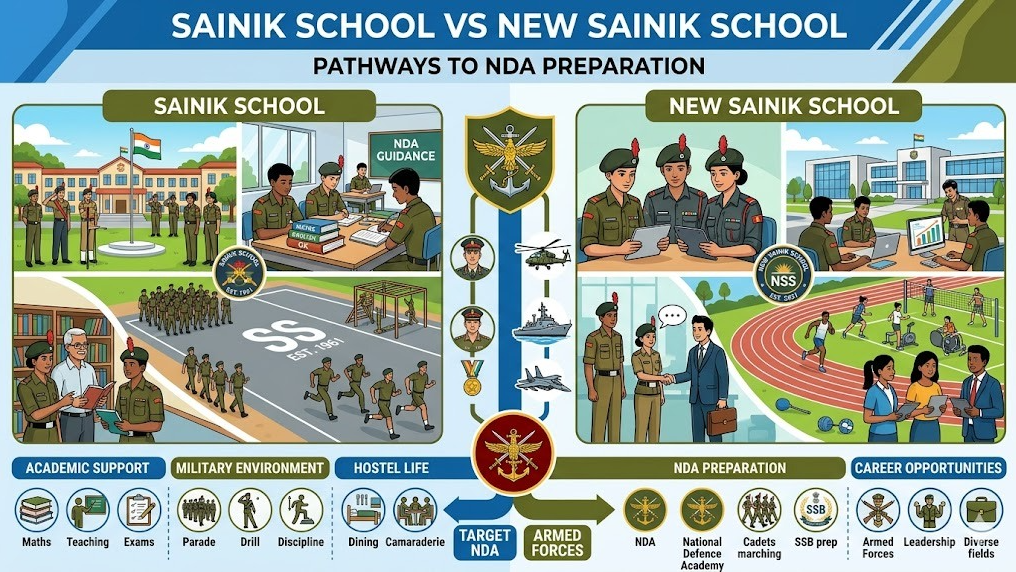
Parents ask this question after getting an NSS allotment. Sometimes they ask it before filling the choice list, trying to decide how seriously to consider those schools. Either way - the answer matters, and it deserves more than a vague "both are good."
The truth is more specific than that. For NDA preparation, what your child experiences day-to-day inside the school matters far more than the name on the gate. And that daily experience differs significantly between an Old Sainik School and a New Sainik School.
Here's the honest breakdown.
What Old Sainik Schools Were Built to Do
Old Sainik Schools are fully residential schools under the Ministry of Defence, established to prepare students for the National Defence Academy ↗ and other defence service entries.
India's Sainik Schools have produced thousands of NDA officers, military leaders, and civil servants. That track record exists because the schools were designed from the ground up with one purpose - taking a child at age 11 and spending six years building the academic foundation, physical fitness, mental resilience, and officer-like qualities that NDA selection demands.
Sainik Schools follow the CBSE curriculum but with a strong emphasis on subjects crucial for NDA success - Mathematics, English, Science, and General Knowledge. Students are trained to think analytically, solve problems quickly, and develop conceptual clarity. Regular tests, competitive exam exposure, and guided study routines help students become comfortable with the type of questions asked in NDA written exams.
None of that is accidental. It's institutional design. The entire academic framework of an Old Sainik School exists in service of a specific outcome.
The Daily Environment - Where Old Sainik Schools Win Clearly
One of the biggest advantages of studying in a Sainik School is the disciplined environment. Daily routines include physical training, parade, and structured study time from the very first week of Class 6.
Sainik Schools consciously nurture Officer-Like Qualities - OLQs - such as leadership, communication, decision-making under pressure, and team responsibility. Students are trained to think like leaders, not just exam candidates - a major advantage during NDA and SSB stages.
This is where the gap between Old and New Sainik Schools is most pronounced. OLQ development isn't something you can achieve through a curriculum change or a motivational poster. It comes from the residential environment - eating together, living together, competing together, solving problems together, being held accountable every single day by peers and staff who take the same things seriously.
Sainik School students tend to perform better at the SSB interview because they have already developed leadership presence through group activities, leadership roles, and exposure to structured decision-making scenarios. Their exposure gives them a natural edge during group discussions and tasks.
A day scholar attending an NSS school - going home every evening - simply doesn't build the same residential formation. It's not a criticism of those schools. It's just what the residential environment produces that a day school format cannot replicate.
Physical Fitness - The Daily Training Advantage
NDA selection has a rigorous physical fitness component. Candidates who arrive at NDA without a background of structured daily physical training face a steep adjustment curve.
Physical fitness plays a major role in NDA selection. Old Sainik School students are usually physically well-prepared compared to many other candidates because physical training is embedded into every school day from Class 6 onward.
Old Sainik Schools run mandatory physical training - PT, parade, sports - every single day. It isn't optional. It isn't an extracurricular. It's part of the timetable, part of the school's identity, part of what makes the morning routine at a Sainik School look different from any other school in India.
New Sainik Schools vary enormously here. Schools that are genuinely residential with dedicated PT infrastructure run something similar. Schools that operate as day programs with physical training sessions a few times a week - the cumulative physical preparation is fundamentally different.
Students who start preparing early develop habits that are difficult to build later - discipline, fitness, and clarity of purpose. Sainik Schools provide this head start, making the transition to NDA smoother and more natural.
Where New Sainik Schools Can Still Work for NDA
To be fair - the picture isn't all one-sided.
Not every child who walks out of an Old Sainik School joins the NDA. And not every NDA officer came through a Sainik School. While Sainik School students do have certain advantages, selection is never guaranteed. Many students from regular schools clear the NDA every year through consistent effort and proper guidance.
A well-run New Sainik School - particularly one that is genuinely residential, CBSE-affiliated, physically active, and staffed by people who understand the defence preparation mission - can provide a meaningful foundation. The school type matters less than what the school actually does every day.
The Central Government provides financial support to deserving students in New Sainik Schools, including a fee support grant of up to Rs 40,000 per annum for 50% of the class strength. That financial accessibility matters. A family that cannot access an Old Sainik School - because of cut offs, geography, or finances - can use a strong NSS as a genuine alternative, not a consolation.
The question to ask before accepting any NSS allotment is specific: Is this school fully residential? Does it run daily PT and parade? Is it CBSE-affiliated with English medium? Does it have NCC integration? What is the actual track record of students from this school in competitive defence exams?
Those questions - answered honestly by the school - tell you more than the NSS tag itself.
The Honest Verdict
For NDA preparation specifically, an Old Sainik School with a genuine residential programme, daily physical training, CBSE curriculum, and established defence preparation culture is the stronger environment. The institutional design has decades of refinement behind it.
A New Sainik School that is fully residential, actively running physical training, and genuinely focused on defence career preparation can still be a strong foundation - especially if the alternative is a regular day school.
A New Sainik School that operates as a day school with a Sainik-pattern label but without the residential environment - that is the least beneficial option for a child who wants to join NDA. The label doesn't produce NDA officers. The daily lived experience does.
Sainik School is more than just an educational institution - it is a leadership incubator. The values learned remain beneficial regardless of the career chosen. Choose the school that actually delivers that environment - Old or New - not the one with the better-sounding name.