
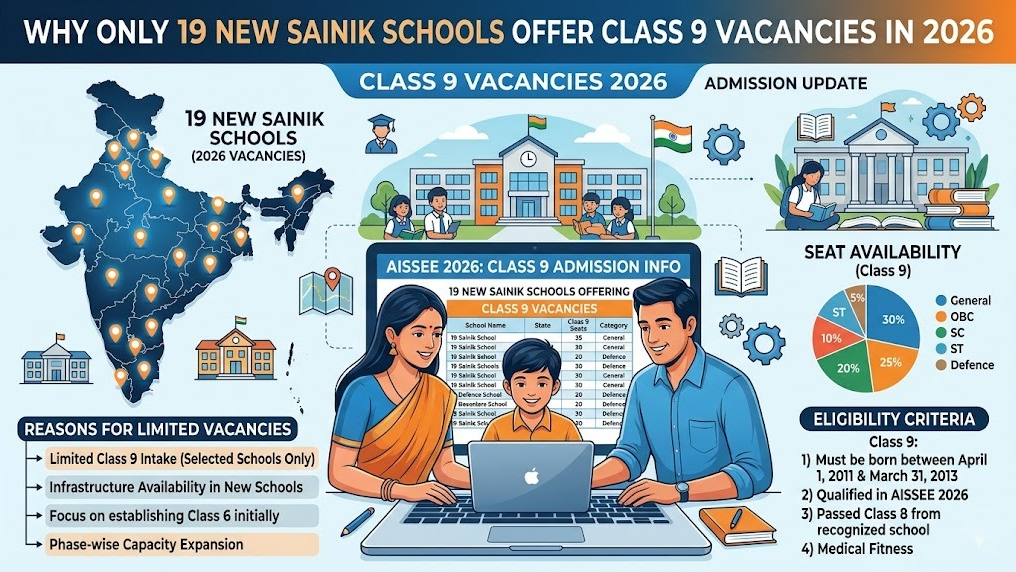
When Class 9 candidates and their parents open the AISSAC seat matrix, something confusing jumps out immediately. There are dozens of New Sainik Schools listed. But search for Class 9 vacancies among them and the number drops sharply - only 19 schools have actual seats available at this level in 2026.
The first reaction for most families is: "Why is it so few? Did something go wrong with the others?"
Nothing went wrong. The answer comes from how New Sainik Schools are structured and how they grow. And once you understand it, the 19-school figure makes complete sense.
How New Sainik Schools Build Their Classes
New Sainik Schools don't open fully formed. They start with Class 6 intake and grow upward one year at a time.
Admission in approved New Sainik Schools for the Sainik School stream is open only at Class 6 level as the primary entry point. Class 9 admission is limited and depends on vacancy.
Think about what that means structurally. An NSS school approved in 2022 admitted its first Class 6 batch in 2022-23. By 2024-25, that batch reached Class 8. By 2025-26, they're in Class 9. That's the first year this school can realistically have a Class 9 vacancy through the Sainik School vertical.
Schools approved in 2023 or later simply haven't had a Class 6 batch progress to Class 9 yet. There are no Class 9 seats to offer - not because the school doesn't want to take Class 9 students, but because the Sainik School stream within the institution hasn't existed long enough to have students at that level yet.
The 60% Internal Route Explains the Small Number Further
The internal 60% route - filled by students already studying at that specific NSS - is the primary source of Class 9 students at New Sainik Schools.
Up to 60% of the seats in New Sainik Schools will be filled by those who are currently studying in any of the approved New Sainik Schools. They are filled on the basis of rank secured in the school-wise merit list.
For a school to have Class 9 vacancies through this route, it needs students who enrolled in Class 6 through the Sainik School vertical a few years ago and have now progressed to Class 8, qualifying for Class 9 admission. Only schools with at least three years of Sainik School vertical operation can generate this pipeline.
The 40% external route adds some external Class 9 seats on top - but only where the school actually has Class 9 vacancy in the first place. If the internal route generates no Class 9 students - because the school is too new - there's nothing for the external route to fill either.
In cases where the school is unable to fill its seats with Category B internal students, the vacancies will be filled by drawing candidates from the 40% All India Merit List. But this only kicks in when the school has confirmed vacancies. No vacancy means no external route either.
Which Schools Have Class 9 Vacancy and Why
The 19 NSS schools that do have Class 9 seats in 2026 are the ones that were approved and started their Sainik School vertical early enough - typically in 2021, 2022, or early 2023. Their first Class 6 batches have now reached Class 9.
The government's goal is to establish 100 New Sainik Schools under the PPP model across India. The expansion has been rapid. But rapid expansion at the Class 6 entry level doesn't automatically translate to Class 9 availability - it just means the Class 9 vacancy numbers will grow each year as more early-cohort students progress through the system.
By 2027, the number of NSS schools with Class 9 vacancies will be higher than 19. By 2028, higher still. The number reflects the age of the school's Sainik School stream, not the school's ambition or quality.
What "Vacancy" Means at the Class 9 Level
Even where a school has Class 9 vacancy, the numbers are small.
Sainik School seats for Class 9 are limited and vary from one school to another. Many schools that accept dozens of Class 6 students take only a handful - sometimes just 5 to 10 - at Class 9.
At NSS schools, the vacancy is driven by how many internal students from the current Class 8 cohort chose to stay in the Sainik School vertical versus those who moved into the regular school stream. In some NSS schools, a large proportion of the original Class 6 Sainik batch transitions out - leaving more vacancy for external Class 9 candidates. In others, most students stay - leaving almost nothing for external applicants.
There are a total of 871 seats available for Class 9 at New Sainik Schools for girls in 2026. Even with that total spread across 19 schools, the per-school, per-category, per-gender number can be very small - sometimes 2 to 5 seats per category at a given school.
What This Means for Class 9 Candidates Using AISSAC
For Class 9 candidates looking at NSS options, the practical implications are significant.
First - don't assume every NSS school in the AISSAC portal has Class 9 seats. Many don't. Check the seat matrix before adding any NSS to your choice list. Adding a school with zero Class 9 vacancy wastes a precious slot on your 10-choice list.
Second - the 19 schools that do have Class 9 seats are spread unevenly across states. Some states have multiple NSS schools with Class 9 vacancy. Others have none. Geography matters here more than it does at Class 6.
Due to limited seats across Sainik Schools, competition remains high every year. At the Class 9 level, this pressure is more acute - a Class 9 candidate with a good rank who fills only 4 or 5 choices is taking a serious risk.
With only 19 NSS schools offering Class 9 seats and even fewer with meaningful vacancy in your specific category, adding all of them that do have seats - along with Old Sainik School Class 9 options - is the right approach. Don't curate too aggressively.
Third - the 40% route at NSS Class 9 schools has no domicile or category filter. A strong AISSEE ↗ rank at Class 9 competes in a clean national merit pool at these schools. That can work in your favour if your score is competitive but you've been squeezed out of Old Sainik School allotment by domicile or category dynamics.
Will More NSS Schools Have Class 9 Seats Next Year?
Almost certainly yes. The schools approved in 2022 and 2023 are now building their Class 9 cohorts through the 60% internal route. By AISSEE 2027 and 2028, the number of NSS schools with Class 9 vacancies should expand meaningfully.
For families whose child is currently in Class 7 at an NSS and planning for Class 9 entry in 2028 - the options will likely be broader than what's available in 2026. But for the current cycle, the 19-school figure is the reality, and working within it requires specific research rather than assumptions.