
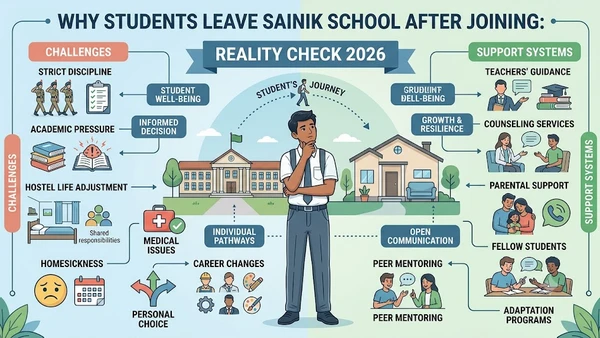
Nobody talks about this in the weeks after AISSEE ↗ results.
Everyone is focused on cut offs, counselling, seat allotment, medical tests. The question in every parent's head is "will my child get in?" Not "will my child stay?"
But here's something worth sitting with. Every year, a portion of students who join Sainik School - some in Class 6, some in Class 9 - don't complete their education there. They take transfer certificates and return home. Some leave in the first term. Some after Class 10. The reasons vary. The families involved rarely broadcast it.
This isn't a reason to avoid Sainik School. It's a reason to go in with clear eyes - understanding what the environment actually demands, and whether your child is genuinely ready for it.
Reason 1 - Homesickness That Doesn't Resolve
This is the most common reason for early departure, particularly among Class 6 entrants who are 10 to 11 years old when they join.
Sainik School is a full residential school. Your child leaves home - possibly for the first time - and enters a structured environment where the schedule runs from before dawn to after dark, personal time is limited, and family contact is restricted to occasional visits and weekly phone calls.
Some children adapt within the first few weeks. The structure becomes comfortable, the peer group becomes family, and the school becomes home. These students thrive.
Others don't adapt on that timeline. They carry homesickness through the first term, the second term, and by the end of Class 6 the family decides to bring them home. This isn't weakness - it's a genuine mismatch between a child's developmental readiness for separation and the early age at which they joined.
What it means practically: before applying, genuinely assess whether your child has any prior experience with extended separation from family. A child who has attended overnight camps, participated in school trips with long stays, or boarded during a sports programme - even briefly - has tested their resilience in some form. A child who has never spent more than a night away from home at age 10 is going into the deep end with no preparation.
This can be addressed before admission. Short residential experiences - summer camps, NCC junior programmes, sports academies - give children a taste of institutional living before the full commitment.
Reason 2 - The Daily Routine Is Harder Than Expected
The image of Sainik School that most families carry is a place of discipline, leadership, and pride. That image is accurate. What it doesn't capture is what the daily experience of that discipline actually feels like from inside.
The Sainik School day begins early - typically 5 AM - with physical training, parade, and assembly before academic classes begin. Study hours run after school. Evening sports are mandatory. Lights out follows at a fixed time. There is no negotiating the schedule, no sleeping in, and no opting out of the physical component because of preference or mood.
For a child who is genuinely enthusiastic about physical activity, leadership, and military culture - this routine is energising. For a child who is academically motivated but physically reluctant - or one who was pushed into applying by parents more enthusiastic than the child - the daily grind can feel punishing rather than purposeful.
Students who leave during the first year most commonly cite the physical demands and the inflexibility of the schedule as the breaking point. Not because the school is doing something wrong - but because the expectation they carried into admission was significantly different from the reality they found inside.
The preparation for this: before admission, be honest about whether your child actually wants this life. Not whether they want the Sainik School certificate. Whether they want the 5 AM wake-up, the parade ground, the compulsory physical training, the structured schedule with minimal personal flexibility. A child who genuinely wants those things will endure the adjustment. A child who was sold on the idea by parents will look for the exit.
Reason 3 - Academic Pressure at a High-Stakes School
Sainik School academic standards are genuinely demanding. CBSE curriculum, competitive peer environment, structured study hours, and the underlying pressure of NDA preparation running throughout the school career - for most students this is productive pressure. For some, it becomes overwhelming.
A child who coasted through primary school on natural ability without developing strong study habits encounters Sainik School academics and discovers that natural ability alone doesn't carry you here. Peers who also qualified AISSEE are working hard too. The competitive floor is high.
Students who struggle academically and don't seek help quickly - either from teachers, senior cadets, or family during visits - sometimes slip far enough that returning to a regular school feels like the only viable option.
What prevents this: building genuine study habits before joining. A child who knows how to sit with a difficult problem, how to seek help, and how to manage a structured study routine is far better equipped than one who found academics effortless without much effort. The transition into Sainik School academics hits harder when a child has no experience of genuine academic struggle and recovery.
Reason 4 - Career Direction Changes
Some students join Sainik School at Class 9 or continue through Class 10 and then reassess their life goals. The original motivation was NDA and defence career. But during secondary school, interests shift - engineering, medicine, entrepreneurship, civil services start to feel more compelling.
Some students leave Sainik School after Class 10 not because of failure or distress but because they've decided they want to pursue something other than NDA, and they feel a specialised coaching environment - Kota for JEE, or a dedicated school for NEET preparation - better serves the new direction.
If you want to join IIT or want to crack NEET, taking a transfer certificate from Sainik School and transitioning to outside coaching is a considered decision that many alumni have made. Sainik School education is genuinely valuable for many careers beyond defence - but the school isn't designed as a JEE or NEET prep institution. Students who realise mid-journey that their goals have changed make a rational decision to seek the environment that matches the new direction.
This is the least preventable reason for departure - career direction naturally evolves during adolescence. What it highlights for families entering Sainik School at Class 6 is the importance of letting the child's interests develop organically within the school, rather than locking them into the NDA path so rigidly that a natural change of direction feels like failure.
Reason 5 - Peer Environment Challenges
Sainik School places students in dormitories with 20 to 40 peers from across different states and backgrounds. The peer environment is one of the school's genuine strengths for most students - it builds social adaptability, national identity, and lifelong friendships. For a minority, the peer dynamics in the first year are genuinely difficult.
Ragging - though officially prohibited and actively managed - can occur in any residential school environment. Senior-junior dynamics, dormitory culture, and the competitive spirit of the environment can occasionally tip into something harmful for specific students. Students from vastly different socioeconomic or regional backgrounds are suddenly living together at close quarters.
Most students navigate this with the resilience the environment itself builds. A few don't - and they return home having experienced peer dynamics that the school couldn't fully protect against.
This is the hardest factor to assess in advance. It requires ongoing honest communication between parent and child through every visit and phone call - not cheerful updates but genuine check-ins about the dormitory environment, relationships with seniors, and whether there's anything that feels unsafe.
What This Means Before You Apply
None of these reasons should make you not apply to Sainik School. They should make you apply honestly.
The families whose children thrive at Sainik School share a few common characteristics. The child genuinely wanted to be there - not just the parent. The child had some prior experience with structured environments or residential separation. The family communicated openly about what the school would actually be like, not just the aspiration it represented.
The families whose children leave early often share a different profile. The parent drove the application more than the child did. The child's vision of Sainik School was shaped by brochures and aspirational stories rather than honest accounts of 5 AM parade in December. The adjustment period was treated as a problem to endure rather than a transition to actively support.
Sainik School is more than just an educational institution - it is a leadership incubator. The values and discipline learned there genuinely benefit students across careers, not just defence. But it demands a specific kind of child - not the smartest or the most athletic, but one who is genuinely ready for that life and not merely hoping they'll become ready after arriving.